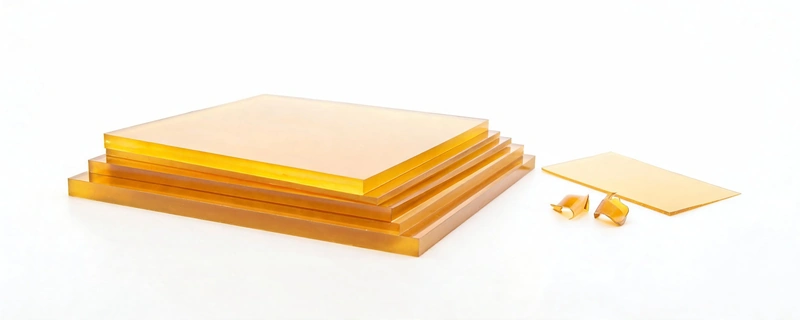
PEI (Polyetherimide) sheet is a high-performance amorphous thermoplastic stock shape known for its natural amber transparency, mechanical strength, thermal performance and electrical insulating properties. It is used in selected engineering applications where several of these characteristics are required in one material.
Compared with conventional engineering plastics, PEI can offer a useful balance of stiffness, dimensional stability and elevated-temperature performance. However, the right material choice depends on the specific grade, operating environment and component design.
1. What Is PEI Sheet?
PEI stands for polyetherimide. It is an amorphous thermoplastic polymer with aromatic imide and ether structures. Unlike semi-crystalline polymers such as PEEK, PEI does not develop the same type of crystalline structure during cooling.
This amorphous structure contributes to its characteristic amber transparency. Depending on the grade and manufacturing process, PEI sheet can be supplied in different thicknesses and dimensions for subsequent machining or fabrication.
PEI is often considered when a design requires a combination of mechanical strength, electrical insulation and heat resistance. It is not simply a transparent alternative to other high-performance plastics; its chemical compatibility, impact behavior and processing characteristics must also be considered.
2. Key Properties of PEI Sheet
Natural Amber Transparency
Unfilled PEI typically has a transparent amber or yellowish-brown appearance. This can be useful in components where visual inspection, light transmission or a translucent material appearance is required.
Transparency is affected by sheet thickness, surface finish, formulation and processing. Do not assume that every PEI grade or thick section will provide the same optical clarity.
Thermal Performance
PEI is used in applications exposed to elevated temperatures. It can retain useful mechanical performance under conditions where many standard thermoplastics become unsuitable. Nevertheless, continuous service temperature is not a single universal number. Load, exposure duration, chemical contact and the selected grade all affect long-term performance.
Mechanical Strength and Stiffness
PEI offers a useful combination of tensile strength and stiffness for structural and precision components. Its performance under load depends on temperature, geometry, stress concentration and exposure time.
Electrical Insulation
Certain PEI grades are used in electrical and electronic components because of their insulating characteristics. For electrical design, engineers should check dielectric strength, dielectric constant, dissipation factor and electrical performance at the actual material thickness and service conditions.
Flame Performance
Some PEI grades provide favorable flame-retardant properties. However, flame classification and smoke performance are grade-specific and test-standard dependent. Confirm the relevant test report or certification before using PEI in a regulated application.
3. Typical Applications of PEI Sheet
Electrical and Electronic Components
PEI sheet can be machined into insulating supports, electrical fixtures, housings and precision components. Its mechanical and electrical properties make it a candidate for designs requiring both structural support and insulation.
Industrial Equipment and Fixtures
PEI stock shapes are used for selected machine components, test fixtures, spacers and structural parts. The material should be evaluated against the expected mechanical load, operating temperature and chemical exposure.
Medical and Laboratory Equipment
Certain PEI grades are used in reusable equipment components and laboratory applications. Some grades may be suitable for repeated steam sterilization, but this must be verified against the actual sterilization cycle and component design.
Medical-device suitability also depends on the applicable regulatory requirements, biological evaluation, cleaning chemicals and material documentation. A PEI designation alone does not establish medical approval.
Transportation and Aerospace Interiors
PEI may be considered for selected interior and technical components where weight, mechanical performance and flame-related requirements are important.
Aerospace and transportation applications often require specific flame, smoke and toxicity testing. The exact material grade and applicable industry requirements must be confirmed before specification.
4. When Should You Choose PEI Sheet?
PEI sheet may be worth evaluating when a component requires several of the following characteristics:
- Good mechanical strength and stiffness for its intended service conditions.
- Electrical insulating performance.
- Useful thermal performance at elevated temperatures.
- Natural amber transparency in unfilled grades.
- Grade-specific flame-retardant performance.
- Machinability into custom engineering components.
The final decision should also account for chemical exposure, impact requirements, moisture conditioning, long-term loading and total component cost.
5. When Is PEI Sheet Not the Best Choice?
PEI is a high-performance polymer, but it is not suitable for every demanding environment.
- Aggressive chemical exposure: Certain solvents, strong alkaline chemicals and other aggressive media may attack PEI or cause environmental stress cracking.
- High-wear sliding applications: If friction and wear dominate the design, a suitable filled PEEK, PAI or another wear-grade material may deserve evaluation.
- High impact or severe notch loading: Stress concentration, sharp corners and impact conditions should be carefully reviewed against the grade's mechanical data.
- Optical applications requiring colorless clarity: Natural PEI is typically amber rather than water-clear. Another material may be more appropriate if optical appearance is critical.
Chemical resistance should never be judged by polymer name alone. Compatibility depends on the chemical, concentration, temperature, exposure time, mechanical stress and material grade.
6. PEI Sheet CNC Machining Considerations
PEI sheet can be machined into custom components using conventional CNC milling, drilling and turning processes where the geometry allows. However, machining quality depends on tool selection, heat management, stock condition and residual stress.
Use Suitable Cutting Tools
Sharp cutting tools with suitable geometry help reduce cutting forces and local heat generation. Carbide tooling is a common starting point, but the optimal tool depends on the machining operation, production volume and material grade.
Control Heat During Machining
Excessive heat can contribute to dimensional changes, surface defects and stress-related problems. Use appropriate cutting parameters, chip evacuation and cooling methods for the specific setup. Avoid allowing chips to accumulate around the cutting area.
Manage Clamping and Residual Stress
Excessive clamping force can deform the workpiece or introduce additional stress. Thin sections and complex geometries may require suitable support and staged machining.
Residual stress in the original stock and stress introduced during machining can affect dimensional stability. For demanding parts, a staged machining strategy and intermediate inspection may help identify movement before final machining.
Consider Annealing When Appropriate
Annealing may be considered for certain PEI stock materials and precision-machining processes to manage residual stress. It is not automatically required for every PEI sheet. The correct procedure depends on the grade, stock condition, part geometry and supplier recommendations.
7. PEI vs PEEK vs PPS: How to Compare?
PEI, PEEK and PPS are all high-performance thermoplastics, but they serve different engineering needs. The following comparison is a general selection guide, not a substitute for comparing individual grade datasheets.
PEI vs PEEK
PEI is an amorphous polymer with natural amber transparency and useful electrical and flame-related properties in selected grades. PEEK is semi-crystalline and is often evaluated for demanding mechanical, chemical and wear applications. PEEK may be preferable in some aggressive environments, but the correct choice depends on the actual grade and service conditions.
PEI vs PPS
PPS is a semi-crystalline polymer known for its chemical resistance and dimensional performance in selected industrial environments. PEI may be preferred where transparency, electrical properties or particular mechanical characteristics are important. Chemical compatibility and temperature requirements should guide the comparison.
8. How to Select the Right PEI Sheet
Before purchasing PEI sheet, confirm the following requirements with your supplier:
- Material grade: Virgin, modified or reinforced grade, including the manufacturer reference where applicable.
- Dimensions: Required thickness, width and length.
- Quantity: Prototype, small-batch or production requirement.
- Application: Electrical, mechanical, medical-related, industrial or other intended use.
- Operating environment: Temperature, mechanical load, chemical exposure and sterilization conditions.
- Documentation: Datasheet, test reports and application-specific compliance documents where required.
- Machining requirements: Whether the sheet will be used as stock material or machined into finished components.
Clear specifications help reduce material-selection errors and make quotations more accurate.
9. Storage and Handling
PEI sheet should be stored in a clean, dry environment and protected from scratches, contamination and unnecessary mechanical stress. Keep the material flat and adequately supported to reduce the risk of distortion during storage.
Before precision machining, allow the stock material to stabilize under suitable workshop conditions. If moisture conditioning or drying is relevant to the selected grade and process, follow the material supplier's recommendations.
Avoid exposing the sheet to unverified cleaning agents, solvents or chemicals. For critical applications, evaluate compatibility before introducing a new cleaning or storage procedure.
10. PEI Sheet Supply from Teda Plastics
Teda Plastics supports overseas buyers sourcing engineering plastic materials and semi-finished stock shapes. We can discuss PEI sheet requirements for machining, industrial components and other technical applications.
To help us evaluate your request, please provide the required thickness, width, length, grade or brand reference, quantity and application. If you need finished parts, drawings and tolerance requirements are also helpful.
Our team can review your specifications and discuss suitable material options according to the project requirements and product availability.
Frequently Asked Questions About PEI Sheet
1. What is PEI sheet?
PEI sheet is a semi-finished stock form made from polyetherimide, an amorphous high-performance thermoplastic. It is valued for its combination of mechanical strength, thermal performance, electrical properties and natural amber transparency.
2. Is PEI sheet transparent?
Unfilled PEI is naturally transparent and commonly has an amber appearance. Actual light transmission depends on grade, thickness, surface finish and processing.
3. What are the main applications of PEI sheet?
PEI sheet is used for selected electrical insulating components, industrial fixtures, precision-machined parts, equipment housings and other applications requiring a combination of thermal and mechanical performance.
4. Can PEI sheet withstand autoclave sterilization?
Some PEI grades are used in repeated steam sterilization applications. Suitability depends on the grade, sterilization cycle, exposure time, component design and service-life requirements. Confirm compatibility with the material manufacturer.
5. Is PEI sheet resistant to chemicals?
PEI has useful resistance to many chemicals but can be affected by certain solvents, strong alkaline chemicals and other aggressive environments. Compatibility should be evaluated for the specific chemical, concentration, temperature, exposure time and grade.
6. Can PEI sheet be CNC machined?
Yes. PEI sheet can be machined into custom components using suitable cutting tools and machining conditions. Tool geometry, heat management, clamping, residual stress and part geometry should be considered.
7. Does PEI sheet need annealing before machining?
Annealing may be considered for certain stock materials and precision-machining processes to manage residual stress. The need, temperature and procedure depend on the material grade, stock condition and supplier recommendations.
8. What information is needed for a PEI sheet quotation?
Provide the required grade or brand reference, sheet thickness, width, length, quantity, application and destination country. For machined parts, include drawings and dimensional tolerances.