PI CNC machining is used to manufacture precision polyimide components for demanding industrial applications. Polyimide is known for its thermal performance and mechanical properties, but machining it requires careful consideration of material grade, stock condition, cutting tools and component geometry.
Compared with many conventional engineering plastics, some PI stock materials can be relatively hard, brittle or abrasive. Poor machining practices may lead to edge chipping, dimensional variation, surface defects or unnecessary material waste.
1. What PI Materials Can Be CNC Machined?
Polyimide (PI) is a family of high-performance polymers. Certain PI materials are supplied in machinable stock shapes such as rods, sheets and blocks, which can be processed using conventional CNC milling, turning and drilling equipment with suitable tooling and process control.
The machinability of PI depends on its specific formulation, manufacturing route, reinforcement, dimensions and material condition. Different grades may respond differently to cutting forces and heat generated during machining.
Before production, it is important to confirm the material grade and obtain its relevant technical information.
2. Common PI CNC Machined Components
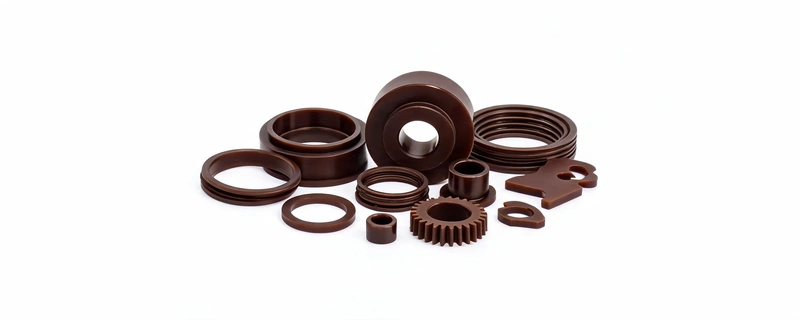
CNC machining allows manufacturers to produce customized polyimide components from semi-finished stock materials. Common component types include:
- Insulators: Custom electrical insulation components for selected high-temperature applications.
- Bushings and sleeves: Precision cylindrical components used in mechanical assemblies.
- Wear components: Selected guides, supports and contact parts where the PI grade meets the wear requirements.
- Thermal protection components: Parts designed for applications involving elevated temperatures.
- Semiconductor equipment components: Custom precision parts for specialized equipment, subject to cleanliness and application requirements.
- Custom engineering parts: Spacers, plates, fixtures and other components manufactured from customer drawings.
3. Tooling Selection for PI Machining
Tool selection should be based on the specific PI grade, component geometry, production volume, required surface finish and dimensional tolerance. There is no single cutting tool that is ideal for every polyimide material.
Carbide Cutting Tools
Suitable solid carbide tools are commonly considered for machining many PI stock materials. Sharp cutting edges, appropriate tool geometry and stable cutting conditions help reduce cutting forces and edge damage.
Diamond and PCD Tooling
Diamond-coated or polycrystalline diamond (PCD) tooling may be considered for particular abrasive formulations, demanding surface finishes or production requirements. The choice depends on the material and machining operation.
Tool Condition
Worn or damaged cutting edges can increase cutting forces, heat and the risk of chipping. Tool condition should be monitored, especially when machining abrasive or filled grades.
4. Dust Extraction and Workplace Safety
PI machining can generate fine chips and dust, particularly during milling, drilling and finishing. Dust management is important for workplace cleanliness, operator protection and reliable machine operation.
- Local extraction: Use suitable dust extraction close to the cutting area.
- Appropriate filtration: Select extraction and filtration equipment suitable for the generated material dust.
- Workplace housekeeping: Remove accumulated dust using suitable industrial cleaning methods.
- Personal protection: Follow the material safety data sheet (SDS) and workplace risk assessment for appropriate protective equipment.
- Controlled cleaning: Avoid cleaning methods that unnecessarily disperse fine dust into the surrounding air.
Compressed air should not be used as a substitute for effective dust extraction because it can disperse fine particles into the workplace.
5. Workholding and Edge Protection
Proper workholding is essential when machining PI components, particularly thin sections, small parts and components with delicate edges.
Use Stable, Even Clamping
Excessive clamping pressure may deform or damage a component. Use suitable fixtures and distribute clamping forces evenly wherever possible.
Prevent Vibration
Insufficient support can cause vibration, chatter and poor surface finish. Keep tool overhangs reasonable and support the workpiece close to the machining area.
Protect Thin Features
Thin walls, narrow ribs and small projections can be vulnerable to cutting forces. Consider machining strategies that provide adequate support until the final finishing operations.
6. Dimensional Tolerances in PI CNC Machining
Achievable dimensional accuracy depends on several factors, including part size, geometry, material grade, stock condition, machining sequence, fixturing and inspection conditions.
A tolerance such as ±0.02 mm may be achievable for selected features and component geometries under controlled conditions. It should not, however, be treated as a universal tolerance for every PI machined part.
| Factor | Potential Effect | Recommended Consideration |
|---|---|---|
| Part Geometry | Thin walls and complex features can increase deformation risk. | Optimize wall thickness and provide adequate support. |
| Material Condition | Internal stress and stock variation may affect stability. | Confirm stock condition and machining recommendations. |
| Tool Wear | Can affect surface finish and dimensional consistency. | Monitor tool condition and cutting performance. |
| Machining Sequence | Uneven material removal may cause dimensional movement. | Consider staged roughing and finishing operations. |
| Inspection Conditions | Temperature and measurement methods affect results. | Use controlled inspection conditions and suitable instruments. |
For precision projects, critical dimensions should be identified on the drawing before quotation. This allows the machining process and inspection method to be evaluated properly.
7. How to Reduce PI Machining Defects
Common machining issues include chipped edges, surface defects, dimensional variation and damage caused by unsuitable clamping. A controlled process can help reduce these risks.
Edge Chipping
Use sharp tools, suitable cutting parameters and stable workholding. Avoid excessive cutting forces, especially around thin sections and small features.
Dimensional Variation
Review the stock material condition and machining sequence. For demanding parts, consider separating roughing and finishing operations and inspecting critical dimensions at appropriate stages.
Poor Surface Finish
Check tool sharpness, tool geometry, machine stability and cutting conditions. A suitable finishing strategy should be selected according to the PI grade and required surface quality.
Cracking or Part Damage
Avoid excessive clamping force and unnecessarily aggressive machining. Pay particular attention to sharp corners, small holes and thin structural features.
8. Design Guidelines for PI CNC Machined Parts
Good component design can reduce machining difficulty, improve part reliability and help control manufacturing costs.
- Avoid unnecessary sharp internal corners: Use suitable radii where the design permits to reduce stress concentration.
- Review thin-wall sections: Avoid excessively thin features that are difficult to fixture and machine.
- Specify realistic tolerances: Apply tight tolerances only to functional dimensions that genuinely require them.
- Consider machining access: Design holes, slots and pockets so that appropriate tools can reach the features.
- Allow for inspection: Identify critical dimensions and provide suitable measurement access.
9. CNC Machining or PI Molding: Which Is Better?
CNC machining and specialized forming processes serve different manufacturing needs. The best option depends on component geometry, material availability, production volume, tooling investment and dimensional requirements.
| Consideration | PI CNC Machining | Specialized Forming |
|---|---|---|
| Prototypes | Often flexible | Depends on tooling requirements |
| Custom Geometry | Suitable for many drawing-based components | Depends on mold and forming capabilities |
| Tooling Investment | Usually requires machining fixtures and cutting tools | May require dedicated tooling or forming equipment |
| Production Volume | Flexible for low and medium quantities | May be advantageous for suitable repeat production |
| Material Compatibility | Requires machinable PI stock | Requires a grade compatible with the forming process |
Not all PI materials can be molded using the same process. Confirm the grade and manufacturing route before comparing production costs.
10. What Information Is Needed for a PI CNC Quote?
To evaluate a custom PI machining project, provide the following information whenever possible:
- 2D engineering drawing or 3D CAD file.
- Required PI grade or material specification.
- Overall dimensions and critical tolerances.
- Required quantity and expected order frequency.
- Surface finish and inspection requirements.
- Application and operating environment.
Complete technical information helps determine material suitability, machining feasibility and inspection requirements before production.
Frequently Asked Questions About PI CNC Machining
1. Can PI be CNC machined?
Yes. Suitable machinable PI stock shapes, including rods and sheets, can be processed using CNC milling, turning and drilling. The machining strategy depends on the specific material grade and component design.
2. Does PI machining always require diamond tools?
No. Suitable carbide tools may be sufficient for many PI machining applications. Diamond-coated or PCD tooling may be considered for certain abrasive materials, production conditions or surface-finish requirements.
3. What tolerances can be achieved when machining PI?
Tolerances depend on part size, geometry, material condition, machining strategy and inspection conditions. Tight tolerances such as ±0.02 mm may be feasible for selected features, but must be evaluated against the actual drawing.
4. Is PI difficult to machine?
PI can be challenging to machine because some grades are hard, brittle or abrasive. Appropriate tooling, stable workholding, controlled cutting conditions and careful inspection help improve machining results.
5. How should PI machining dust be controlled?
Use suitable local dust extraction and filtration, maintain good workplace housekeeping and follow the material SDS and applicable safety requirements. Avoid cleaning methods that disperse fine dust into the air.
6. What PI materials are available for CNC machining?
Depending on the supplier and grade, machinable PI materials may be available as rods, sheets or blocks. Confirm dimensions, material grade and machinability before ordering.
7. Can PI CNC machined parts be used in high-temperature applications?
Selected PI grades are designed for demanding thermal environments. Actual suitability depends on the grade, operating temperature, mechanical load, exposure time and surrounding conditions.
8. What files should I send for a PI CNC machining quotation?
A 2D drawing or 3D CAD file is recommended. Include the material grade, quantity, critical dimensions, tolerances, surface-finish requirements and application details whenever possible.
9. Can Teda Plastics supply customized PI machined parts?
Contact Teda Plastics with your drawings and material requirements to discuss customized PI components and available material options.
Need Custom PI CNC Machined Parts?
Teda Plastics supports engineering plastic material supply and customized machining inquiries for PI and other high-performance polymers.
Send us your drawings, material specifications and quantity requirements. We can review the project details and discuss a suitable manufacturing solution.
Request a PI CNC Machining Quote