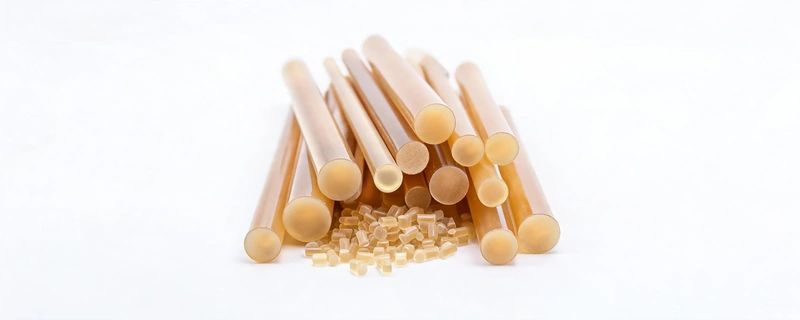
PPSU rod is a round semi-finished stock form made from polyphenylsulfone, an amorphous high-performance thermoplastic. It is valued for its combination of toughness, heat resistance, hydrolysis resistance and dimensional stability.
Compared with many conventional engineering plastics, PPSU can be considered for components exposed to hot water, steam and repeated cleaning cycles. Its natural translucent amber appearance can also be useful in applications where visual inspection is important.
1. What Is PPSU Rod?
PPSU stands for Polyphenylsulfone. It belongs to the sulfone polymer family and is an amorphous thermoplastic known for high toughness and resistance to hot water and steam.
PPSU rod is supplied as cylindrical stock for further machining. Depending on the manufacturer and grade, the material may be produced through extrusion or other suitable stock-shape manufacturing processes. Available diameters, lengths, colors and tolerances vary by supplier.
Natural PPSU is commonly translucent amber or champagne-colored. Its transparency is not equivalent to optical-grade clarity and may vary with diameter, wall thickness, processing conditions and surface finish.
2. Key Properties of PPSU Rod
PPSU is selected when a component needs a balance of mechanical toughness and performance in hot, wet environments. The actual properties depend on the grade and manufacturing process.
| Property | General Characteristics | Engineering Consideration |
|---|---|---|
| Material structure | Amorphous thermoplastic | Does not have the same crystalline structure as PEEK or PPS. |
| Appearance | Usually translucent amber | Appearance varies by grade and stock dimensions. |
| Toughness | High impact resistance | Useful for parts exposed to handling and mechanical impact. |
| Heat resistance | Suitable for demanding elevated-temperature applications | Check the grade's temperature data and actual load conditions. |
| Hydrolysis resistance | Good resistance to hot water and steam | Important for selected reusable and sterilizable components. |
| Electrical properties | Good electrical insulation characteristics | Verify dielectric properties for the operating environment. |
| Chemical resistance | Useful resistance to many chemicals | Check chemical type, concentration, temperature and exposure time. |
3. Typical Applications of PPSU Rod
Medical and Healthcare Equipment
Selected PPSU grades may be considered for reusable medical equipment, instrument components and housings that require resistance to hot water, steam and repeated cleaning. Suitability depends on the grade, regulatory documentation and validation of the finished component.
Fluid Handling Components
PPSU can be machined into fluid connectors, valve components, manifolds and other parts used in water or fluid handling systems. Its toughness and hot-water resistance can be useful in demanding service environments.
Dental and Laboratory Equipment
Selected grades may be used in handles, holders and equipment components exposed to repeated cleaning or sterilization procedures. Chemical compatibility should be checked against the actual cleaning agents and operating conditions.
Industrial and Electrical Components
PPSU's mechanical and electrical properties can make it a candidate for selected insulating parts, structural components and housings operating in elevated-temperature environments.
4. When PPSU Rod May Not Be the Best Choice
PPSU offers useful performance, but it is not the best material for every application. Consider another polymer when the operating environment places greater demands on chemical resistance, friction or mechanical loading.
- Strong chemical exposure: If the component is exposed to aggressive solvents or concentrated chemicals, compare PPSU with PEEK, PTFE or another chemically compatible material.
- Very low friction requirements: PTFE or a suitable filled polymer may be more appropriate for sliding and sealing applications.
- High mechanical loads at elevated temperatures: Compare the long-term mechanical properties of PPSU with PEEK and other high-performance materials.
- Strict optical requirements: Natural PPSU is translucent, but it should not be assumed to meet optical clarity requirements without testing.
5. CNC Machining Considerations for PPSU Rod
PPSU rod can be machined by turning, milling, drilling and other conventional plastic machining operations. However, good results depend on controlling heat, residual stress and workholding pressure.
Use Sharp Cutting Tools
Sharp tools help reduce cutting forces and frictional heat. Tool geometry and material should be selected according to the machining operation, production volume and whether the PPSU grade contains reinforcing fillers.
Control Heat During Machining
Excessive heat can affect dimensional stability and surface quality. Use suitable cutting speeds, feed rates and chip evacuation methods. Coolant may be considered where compatible with the material and subsequent cleaning requirements.
Avoid Excessive Clamping Pressure
Strong clamping forces can deform plastic stock or introduce additional stress. Use suitable soft jaws, fixtures or support surfaces, particularly when machining thin sections.
Plan for Stress and Dimensional Stability
Residual stress can come from stock manufacturing, machining and uneven material removal. For precision components, consider staged machining, balanced material removal and an appropriate stress-relief procedure where recommended for the specific grade.
Inspect After Temperature Stabilization
Allow machined components to reach a stable inspection temperature before final measurement. For tight-tolerance parts, specify the inspection conditions and measurement method in advance.
6. PPSU Rod vs. PPSU Sheet
Both forms use the same base polymer family, but their stock geometries make them suitable for different component designs.
| Comparison | PPSU Rod | PPSU Sheet |
|---|---|---|
| Stock shape | Round bar | Flat plate |
| Typical machining | Turning, drilling, milling | Milling, drilling, profiling |
| Common components | Connectors, bushings, cylindrical parts | Panels, plates, covers and flat components |
| Material selection | Useful for round or rotational geometries | Useful for flat or plate-based geometries |
7. What to Check Before Ordering PPSU Rod
Choosing the correct stock specification helps reduce machining waste and avoid delays during production. Before requesting a quote, confirm the following details:
- Diameter: Specify the required outside diameter.
- Length: Confirm the required rod length and cutting allowance.
- Grade: Identify the required material grade or technical specification.
- Color: Confirm natural amber or any specified color requirement.
- Quantity: Provide the required quantity and expected purchasing frequency.
- Application: Explain the operating temperature, chemical exposure and mechanical conditions.
- Documentation: State any required technical data, compliance documents or application-specific records.
For custom-machined components, provide a technical drawing showing dimensions, tolerances, surface finish and any critical inspection requirements.
8. PPSU Rod Supply from Teda Plastics
Teda Plastics supplies engineering plastic materials in different semi-finished forms and supports custom CNC machining according to customer drawings.
For PPSU rod enquiries, please share your required diameter, length, quantity and material specification. If you need finished components, a drawing or sample details will help us understand your requirements.
We can also discuss other PPSU forms, including sheets, granules, powder and custom-machined parts, subject to grade and availability.
Frequently Asked Questions About PPSU Rod
1. What is PPSU rod?
PPSU rod is a round semi-finished stock form made from polyphenylsulfone, an amorphous high-performance thermoplastic known for toughness, heat resistance and hydrolysis resistance.
2. What color is natural PPSU rod?
Natural PPSU is commonly translucent amber or champagne-colored. The exact appearance depends on grade, diameter, processing and surface finish.
3. Can PPSU rod be used for medical components?
Selected PPSU grades may be considered for medical and healthcare equipment components. The specific grade, regulatory documentation, sterilization conditions and finished-device requirements must be evaluated.
4. Can PPSU withstand repeated autoclaving?
PPSU is known for its resistance to hot water and steam, and selected grades are used in reusable equipment. Actual sterilization life depends on grade, temperature, cycle time, cleaning chemicals, geometry and validation.
5. Is PPSU rod suitable for CNC machining?
Yes. PPSU rod can be turned, milled, drilled and machined into custom components. Tool sharpness, heat control, clamping and stress management are important.
6. Is PPSU more chemically resistant than PEEK or PTFE?
Not generally. PPSU has useful chemical resistance, but PEEK and PTFE may be more suitable in some aggressive chemical environments. Selection depends on the chemical, concentration, temperature and exposure time.
7. What is the difference between PPSU rod and PPSU sheet?
PPSU rod is commonly selected for cylindrical parts such as bushings, connectors and turned components. PPSU sheet is more suitable for flat components, plates, panels and milled parts.
8. What information is needed to request a PPSU rod quotation?
Provide the required diameter, length, quantity, material grade or specification, color preference and destination. For machined parts, include a drawing with dimensions and tolerances.
Looking for PPSU Rod Stock or Custom Parts?
Send us your required dimensions, material specifications or technical drawings. Our team can help review your PPSU material requirements and discuss suitable supply options.
Contact Teda Plastics