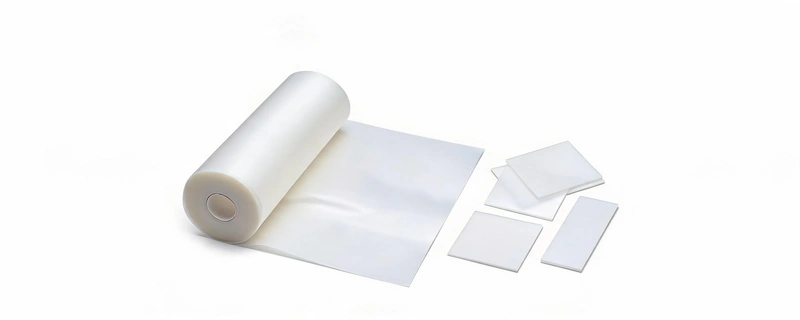
PTFE film is a thin form of polytetrafluoroethylene used in applications that require chemical resistance, low friction, non-stick characteristics and electrical insulation. It is supplied in different thicknesses and formats, depending on the manufacturing process and end use.
1. What Is PTFE Film?
PTFE film is a thin, flexible material made from polytetrafluoroethylene. Compared with thick PTFE sheets and rods, film products are designed for applications where a thin layer, wrap, liner, barrier or release surface is required.
PTFE film should not be confused with PTFE tape, expanded PTFE (ePTFE) membrane or a PTFE coating. These products can have different structures, manufacturing processes and performance characteristics. When sourcing, identify the exact product form required.
2. Common Types of PTFE Film
Skived PTFE Film
Skived PTFE film is typically produced by peeling a thin continuous layer from a molded PTFE billet. It is used in industrial applications that require a thin PTFE layer, including electrical insulation, lining, release and selected gasket applications. Surface finish, thickness range and dimensional tolerances depend on the producer and product specification.
PTFE Dispersion-Coated Film
PTFE dispersion can be applied as a coating to a suitable carrier or substrate and then processed to form a PTFE-coated material. This is different from a free-standing skived PTFE film. If the application requires a self-supporting film, confirm the construction with the supplier rather than assuming that every dispersion-based product is a free-standing PTFE film.
Expanded PTFE (ePTFE)
Expanded PTFE is a porous, expanded structure with properties that differ from dense, non-porous PTFE film. It is used in selected sealing, filtration, venting and membrane applications. Specify ePTFE explicitly when this structure is required.
3. Key Properties of PTFE Film
- Chemical resistance: PTFE is resistant to many industrial chemicals. Compatibility should still be checked for the actual chemical, concentration, temperature and exposure conditions.
- Low friction: PTFE has a naturally low coefficient of friction, which can be useful in sliding and release applications.
- Electrical insulation: PTFE is widely used as an electrical insulating material. Dielectric performance depends on film thickness, construction, test method and service conditions.
- Thermal performance: PTFE can be used in elevated-temperature environments, but the allowable continuous and short-term temperatures must be confirmed for the specific product and application.
- Non-stick and release behavior: Its low surface energy can help reduce adhesion in suitable release applications.
- Flexibility and creep: Thin PTFE film can flex and deform under sustained stress. It should not be treated as a load-bearing structural film without application-specific validation.
4. PTFE Film Applications
Electrical and Cable Insulation
PTFE film can be used as an insulating layer in selected electrical and electronic applications. When specifying film for electrical service, provide the required thickness, voltage conditions, dielectric requirements, operating temperature and applicable test standard. Do not select a film solely from a generic dielectric-strength value.
Composite and Industrial Release
PTFE film and PTFE-based release materials may be used where a low-adhesion surface is needed during processing. Confirm the temperature, pressure, surface contact, reuse expectations and whether a plain film or a coated release material is required.
Gaskets and Chemical Barriers
PTFE film can be considered for thin gasket layers, liners and chemical barriers. Suitability depends on flange design, compression, pressure, temperature, creep behavior and the required sealing performance. For demanding sealing duties, the complete gasket design and operating conditions should be reviewed.
Sliding and Surface Protection
In selected designs, PTFE film can provide a low-friction or protective interface between components. Consider wear, film retention, contact pressure, movement and the condition of the mating surface.
5. How to Select PTFE Film Thickness
There is no single thickness that is suitable for every PTFE film application. The correct selection depends on the function of the film and the way it will be installed or processed.
- Electrical insulation: Define the required electrical performance, voltage, insulation design and test conditions.
- Gaskets: Consider the flange surface, compression, pressure, temperature and sealing design.
- Release applications: Consider handling, conformability, process temperature, pressure and the required service life.
- Protective lining: Consider the substrate, attachment method, chemical exposure and mechanical handling.
- Converting and fabrication: Confirm whether the film will be slit, laminated, die-cut, wrapped or bonded.
When requesting a quotation, specify the required thickness and tolerance rather than relying only on a general description such as “thin PTFE film.” Also confirm roll or sheet format, width, length and surface requirements.
6. PTFE Film vs. PTFE Tape vs. ePTFE
| Product form | Typical construction | Common considerations |
|---|---|---|
| Dense PTFE film | Thin, generally non-porous PTFE layer | Thickness, width, electrical properties, surface and dimensional stability |
| PTFE tape | May be skived film supplied in tape form, or a product with adhesive/backing depending on type | Confirm whether it is adhesive-backed, unsupported or intended for thread sealing |
| ePTFE | Expanded porous PTFE structure | Porosity, permeability, compressibility and sealing or membrane requirements |
| PTFE-coated material | PTFE coating applied to a carrier or substrate | Carrier material, coating thickness, adhesion and operating conditions |
7. Bonding, Printing and Surface Treatment
Virgin PTFE has low surface energy, which makes conventional bonding and printing difficult. If the film must be bonded, laminated, printed or attached to another material, specify this requirement before ordering.
Surface treatment methods may include chemical etching or other supplier-qualified treatments. The appropriate method depends on the adhesive system, substrate, process and required bond performance. Confirm the treated side, treatment condition, storage requirements and expected bonding process with the supplier.
8. PTFE Film vs. PEEK Film and PI Film
PTFE, PEEK and polyimide (PI) films serve different engineering needs. Material selection should be based on the complete application rather than one property in isolation.
| Material | Typical strengths | Selection considerations |
|---|---|---|
| PTFE film | Very good chemical resistance, low friction and electrical insulation characteristics | Relatively soft; consider creep, dimensional stability and bonding challenges |
| PEEK film | Higher mechanical strength and stiffness than PTFE in many film applications | Consider cost, chemical compatibility and the required thermal/mechanical performance |
| PI film | Good thermal performance and electrical insulation in many demanding applications | Consider moisture behavior, chemical exposure, flexibility and grade-specific properties |
Explore our PEEK materials and PI materials for alternative high-performance polymer options.
9. Information to Include in a PTFE Film Inquiry
To help evaluate a PTFE film requirement, provide the following information where available:
- Required film type: dense skived film, ePTFE, coated material or tape.
- Thickness and thickness tolerance.
- Required width, roll length or sheet dimensions.
- Virgin or modified material requirement, if applicable.
- Surface requirements, including treated or untreated sides.
- Application: electrical insulation, release, gasket, lining or another use.
- Operating temperature, chemical exposure, pressure and mechanical conditions.
- Required test standards, technical data and documentation.
- Order quantity and preferred packaging.
10. Storage and Handling
Store PTFE film in clean conditions and protect it from dust, sharp objects, creasing and mechanical damage. Avoid unnecessary stretching or folding, especially for thin gauges. Follow the supplier's recommendations for storage, handling and any surface-treated product, as treatment performance may depend on handling and storage conditions.
11. Frequently Asked Questions
What is PTFE film commonly used for?
PTFE film is used in selected electrical insulation, release, lining, chemical barrier, gasket and low-friction applications. The appropriate product construction depends on the application.
Is PTFE film the same as PTFE tape?
Not necessarily. PTFE tape may be film supplied in tape form, an adhesive-backed product or a thread-sealing tape. Confirm the construction and intended use before purchasing.
Can PTFE film be bonded with adhesive?
Bonding virgin PTFE is difficult because of its low surface energy. A suitable surface treatment and compatible adhesive system may be required. Test the complete bonding process for the intended application.
Is PTFE film suitable for electrical insulation?
PTFE film is used for electrical insulation, but suitability depends on thickness, voltage, temperature, construction, test method and applicable electrical design requirements. Request grade-specific technical information.
What is the difference between PTFE film and ePTFE?
Dense PTFE film is generally non-porous, while ePTFE has an expanded porous structure. Their physical properties and applications are different, so specify the required form clearly.
What information is needed for a PTFE film quotation?
Provide the film type, thickness, tolerance, width or sheet size, quantity, application and any electrical, chemical or surface requirements. Drawings or a product specification are helpful where available.
12. PTFE Film Supplier – Teda Plastics
Teda Plastics Co., Ltd. supplies engineering plastic materials for industrial customers. If you are sourcing PTFE film, share your required product construction, dimensions and application details so that the specification can be reviewed.
For electrical insulation, release, gasket or chemical barrier applications, include the operating conditions and any required test standards when contacting us. This helps avoid selecting a film based on an unsuitable general specification.
Looking for PTFE Film?
Send us your required film type, thickness, dimensions and application details for a product inquiry.
Request a Quote WhatsApp Us