PEEK rod (Polyetheretherketone rod) is a high-performance semi-crystalline engineering thermoplastic used to manufacture precision components for demanding industrial environments.
Compared with conventional engineering plastics, PEEK offers a combination of high mechanical strength, wear resistance, chemical resistance and thermal performance. It is commonly supplied as round rod stock for CNC machining of bushings, seals, bearings, valve components and other precision parts.
What Is PEEK Rod?
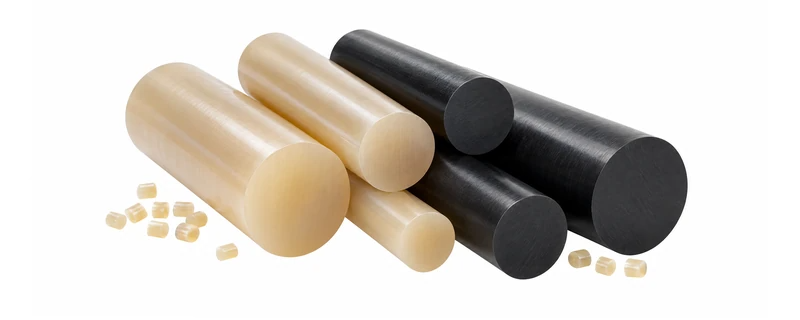
PEEK rod is a solid cylindrical semi-finished product made from polyetheretherketone resin. Depending on the manufacturer, grade, diameter and production requirements, PEEK rods may be produced through extrusion or compression molding.
The material is subsequently machined into finished components such as:
- Industrial bushings and bearings.
- Sealing rings and valve seats.
- Wear-resistant sleeves and guide components.
- Insulating components and precision spacers.
- Custom CNC-machined parts made to customer drawings.
PEEK rod stock allows manufacturers to produce customized geometries without investing in dedicated injection molds. It is particularly useful for low-volume production, complex components and applications requiring machining from solid material.
PEEK Rod Grades: Virgin, CF30, GF30 and Bearing Grades
Different PEEK formulations are designed to address different mechanical, thermal and tribological requirements. The correct grade should be selected according to the operating conditions rather than color alone.
Virgin PEEK Rod
Virgin PEEK is typically natural amber or beige in color. It provides a balanced combination of mechanical strength, toughness, chemical resistance and electrical properties.
It is commonly considered for precision components, chemical equipment and applications where an unfilled PEEK formulation is required. Standard virgin PEEK should not automatically be considered medical-grade or certified biocompatible. Specific grades and documentation are required for regulated applications.
CF30 PEEK Rod – 30% Carbon Fiber Reinforced
CF30 PEEK contains approximately 30% carbon fiber reinforcement by weight in commonly designated grades. It generally offers higher stiffness, improved load-bearing capability and lower thermal expansion than unfilled PEEK.
It is often considered for structural components, wear parts and applications requiring improved dimensional stability. Carbon fiber reinforcement can also change electrical and thermal conductivity, so CF30 should not be selected for electrical insulation without specific verification.
GF30 PEEK Rod – 30% Glass Fiber Reinforced
GF30 PEEK is reinforced with approximately 30% glass fiber by weight in commonly designated grades. It generally provides increased stiffness and improved dimensional stability compared with unfilled PEEK.
It may be suitable for structural components and applications exposed to mechanical loads. However, glass fiber can influence the wear behavior of mating surfaces. Electrical properties must be checked against the specific grade data rather than assumed from the reinforcement type.
Bearing Grade and Tribological PEEK Rod
Bearing-grade PEEK is formulated for applications involving friction, wear and sliding contact. Depending on the manufacturer's formulation, it may contain combinations of carbon fiber, graphite, PTFE or other functional additives.
These grades can be useful for bushings, wear rings and moving components. Friction and wear performance depend on contact pressure, speed, temperature, surface finish, counterface material and lubrication conditions.
Black color alone does not identify a specific PEEK formulation. Always confirm the grade and filler composition using the supplier's technical documentation.
PEEK Rod Sizes and Available Diameters
PEEK rod is available in different diameters and lengths depending on the production method, material grade and supplier's manufacturing range.
Extrusion and compression molding are both used for PEEK rod production. The practical diameter range, dimensional tolerance and internal material characteristics may differ between these processes.
| Specification | What to Confirm |
|---|---|
| Rod Diameter | Required diameter and available manufacturing range |
| Rod Length | Standard length or cut-to-size requirement |
| Material Grade | Virgin, CF30, GF30 or bearing grade |
| Manufacturing Method | Extruded or compression-molded stock |
| Dimensional Tolerance | Diameter tolerance, straightness and length tolerance |
| Documentation | Grade-specific TDS and quality requirements |
If you require a specific PEEK rod diameter, length or grade, send us your specifications for confirmation. Actual availability and lead time depend on the requested material and dimensions.
Technical Properties of PEEK Rod
The following table provides indicative reference values for unfilled virgin PEEK. These are not guaranteed specifications for every PEEK rod. Actual results vary with resin grade, manufacturing process, specimen preparation and test conditions.
| Property | Typical Reference Value | Test Method / Notes |
|---|---|---|
| Density | Approximately 1.30 g/cm³ | ISO 1183 |
| Tensile Strength | Approximately 90–100 MPa | ISO 527; grade and test dependent |
| Flexural Modulus | Approximately 4.0–4.1 GPa | ISO 178; grade and test dependent |
| Glass Transition Temperature (Tg) | Approximately 143°C | DSC reference |
| Melting Temperature (Tm) | Approximately 343°C | DSC reference |
| Continuous Service Temperature | Often referenced around 250°C | Depends on load, environment and grade |
For engineering design, use the technical data sheet for the exact material grade and consider long-term mechanical loading, thermal cycling, chemical exposure and dimensional stability.
PEEK Rod Applications in Industrial Engineering
Oil and Gas Equipment
PEEK components are used in selected oil and gas applications where mechanical strength, temperature resistance and chemical compatibility are important. Potential applications include seal components, backup rings, valve parts and specialized downhole components. Suitability must be verified against pressure, fluid chemistry and operating conditions.
Semiconductor Manufacturing
PEEK may be selected for wafer-handling components, fixtures and precision equipment parts. Material cleanliness, particle generation, chemical compatibility and grade-specific properties should be considered for each application.
Industrial Machinery
PEEK rod is commonly machined into bushings, wear rings, sleeves and other components where conventional metals or plastics may not meet the required operating conditions.
Automotive and Aerospace
Selected PEEK grades are used in lightweight structural components, electrical connectors and precision mechanical parts. Any aerospace or automotive qualification requirements must be confirmed for the specific material and application.
CNC Machining PEEK Rod: Tips and Tolerances
PEEK can be machined using conventional CNC turning and milling equipment. However, its thermal expansion, residual stress and grade-dependent properties require careful process planning.
1. Dimensional Tolerance
Tight machining tolerances are possible for selected PEEK components. Values such as ±0.01 mm may be achievable under suitable conditions, but they are not a universal guarantee.
Achievable tolerances depend on component dimensions, geometry, wall thickness, material condition, machining strategy, temperature control and inspection methods.
2. Tool Selection
Sharp cutting tools and appropriate machining parameters help reduce heat generation and improve surface quality. Reinforced grades such as CF30 and GF30 can be more abrasive than unfilled PEEK, so tool material and tool life should be considered.
3. Heat Management
Excessive cutting heat can contribute to dimensional changes, surface defects and residual stress. Suitable cutting speeds, feed rates, tool geometry and cooling strategies should be selected according to the material grade and component geometry.
4. Annealing and Stress Relief
Annealing may be beneficial for certain PEEK stock materials and precision components, particularly when machining removes a large amount of material or when dimensional stability is critical.
However, annealing is not automatically required for every PEEK rod. The need for stress relief, temperature profile and holding time depend on the stock manufacturing process, material grade, dimensions and machining sequence. Follow the material manufacturer's recommendations.
5. Surface Finish
Surface finish requirements should be specified according to the component's function. For example, a sealing surface or sliding contact area may require a different finish from a general structural component.
A target such as Ra 0.4 μm may be considered for selected precision applications, but the achievable result depends on material grade, geometry, tooling and finishing process.
For custom parts, you can share your drawings with our CNC Machining Services team for technical review.
PEEK Rod vs PEEK Sheet
PEEK rod and PEEK sheet are both semi-finished forms of polyetheretherketone. The main difference is their geometry and the types of components they are used to manufacture.
| Comparison | PEEK Rod | PEEK Sheet |
|---|---|---|
| Shape | Solid cylindrical stock | Flat plate or sheet |
| Typical Components | Bushings, sleeves, seals and rings | Wear plates, spacers and flat components |
| Machining Focus | CNC turning and milling | CNC milling, drilling and profiling |
| Selection Factor | Diameter and length | Thickness, width and length |
If your design requires flat stock rather than cylindrical material, see our PEEK Sheet Guide.
How to Choose the Right PEEK Rod
The best PEEK grade depends on the actual working conditions. Before selecting material, consider the following factors:
- Operating Temperature: Check continuous and peak temperatures, including thermal cycling.
- Mechanical Load: Evaluate tensile, compressive and flexural loading.
- Wear and Friction: Consider sliding speed, contact pressure, lubrication and counterface material.
- Chemical Exposure: Verify compatibility with the actual fluids and cleaning chemicals.
- Electrical Requirements: Confirm dielectric or conductive properties for the selected grade.
- Dimensional Stability: Consider material reinforcement, stock manufacturing method and machining allowance.
- Cost and Production Volume: Compare material grade, stock dimensions, machining time and material waste.
Virgin PEEK may be suitable where an unfilled formulation and balanced properties are required. CF30 and GF30 may be considered when increased stiffness or dimensional stability is needed. Bearing grades should be evaluated for the specific friction and wear conditions.
PEEK Rod Storage and Packaging
Proper storage and handling help protect PEEK rod stock from contamination and physical damage before machining.
- Store rods in a clean and dry indoor environment.
- Protect the surface from scratches, impact and contamination.
- Support long rods adequately to reduce the risk of bending during storage.
- Keep material grade identification and batch information with the stock.
- Use suitable protective packaging during transportation.
Packaging method and rod length should be confirmed before ordering, especially for large-diameter stock and international shipments.
Frequently Asked Questions About PEEK Rod
PEEK Rod Supplier – Teda Plastics
Teda Plastics Co., Ltd. supports international distributors, machining factories and industrial buyers sourcing high-performance engineering plastics.
We work with PEEK rod stock requirements across different material grades and dimensions. We also support inquiries for CNC-machined PEEK components based on customer drawings.
When requesting a quotation, please provide the required grade, diameter, length, quantity and any specific technical or documentation requirements. Material specifications, certifications, availability and lead times should be confirmed for each order.
Need PEEK Rod Stock or CNC Machining?
Send us your required material grade, dimensions or technical drawing. Our team can review your requirements and provide quotation support.
Request a Quote WhatsApp Us