PEEK sheet is a high-performance engineering thermoplastic made from polyetheretherketone. It is widely used for machined components that require a combination of mechanical strength, thermal performance, chemical resistance and dimensional stability.
Compared with conventional engineering plastics, PEEK offers a higher operating-temperature capability and a useful balance of strength and chemical resistance. It is commonly considered for demanding industrial applications where standard plastics may not provide sufficient performance.
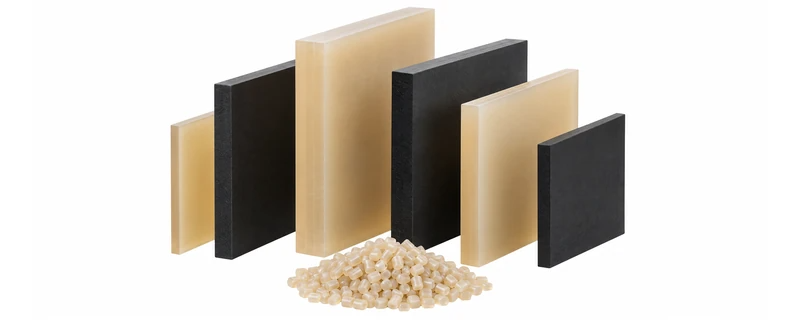
What Is PEEK Sheet?
PEEK sheet is a flat semi-finished product made from polyetheretherketone (PEEK), a semi-crystalline thermoplastic known for its high mechanical strength, thermal stability and chemical resistance.
PEEK sheets are generally produced through processes such as extrusion or compression molding, depending on the material grade, thickness and manufacturer. They are subsequently cut or CNC machined into components such as wear plates, support blocks, electrical components, fixtures and precision structural parts.
The sheet format is particularly suitable for flat or plate-shaped components, while PEEK rods are often selected for cylindrical parts such as bushings, sleeves and seals.
PEEK Sheet Grades: Virgin, CF30, GF30 and Modified Grades
PEEK sheet is available in different formulations. The correct choice depends on mechanical loading, friction, electrical requirements, operating temperature and the working environment.
1. Virgin PEEK Sheet
Virgin PEEK is an unreinforced grade, commonly supplied in natural brown or amber colors. It offers a balanced combination of strength, toughness, chemical resistance and electrical properties.
- Suitable for general-purpose machined PEEK components.
- Good chemical resistance in many industrial environments.
- Useful electrical insulating properties, depending on grade and conditions.
- Does not contain reinforcing fibers in its unfilled formulation.
Standard virgin PEEK should not automatically be considered medical-grade, implant-grade or compliant with a particular food-contact regulation. Specific material grades and supporting documentation are required when these qualifications are important.
2. CF30 PEEK Sheet – 30% Carbon Fiber Reinforced
CF30 PEEK contains approximately 30% carbon fiber reinforcement by weight in a typical formulation. The reinforcement increases stiffness and can improve dimensional stability under suitable loading conditions.
- Higher stiffness than unfilled PEEK in typical formulations.
- Reduced thermal expansion in relevant directions.
- Useful for structural components exposed to mechanical loads.
- Carbon fiber reinforcement can increase electrical conductivity.
CF30 is not normally the first choice when electrical insulation is required. Its wear behavior and suitability for sliding contact should also be evaluated against the mating material, load, speed and lubrication.
3. GF30 PEEK Sheet – 30% Glass Fiber Reinforced
GF30 PEEK is reinforced with approximately 30% glass fiber by weight in a typical formulation. It is often selected when increased stiffness and dimensional stability are required.
- Higher stiffness than unfilled PEEK in typical formulations.
- Improved dimensional stability for selected structural applications.
- Suitable for certain mechanically loaded components.
- Glass fiber can affect surface wear against softer mating materials.
Electrical performance should be checked against the specific grade's technical data rather than assumed from the presence of glass fibers.
4. Bearing and Wear-Modified PEEK Sheet
Bearing or tribological PEEK grades are formulated for applications involving friction, sliding contact or wear. Depending on the manufacturer, they may contain additives such as graphite, PTFE or other solid lubricants and reinforcing materials.
Formulations, colors and friction characteristics vary. Not every black PEEK sheet is a bearing grade, and color alone cannot identify its composition. For wear applications, request the specific grade's friction and wear data and evaluate it under actual operating conditions.
PEEK Sheet Thickness and Available Sizes
PEEK sheet is used in components ranging from thin machined plates to thick structural blocks. Thickness selection depends on the final component dimensions, machining allowance, mechanical loading and dimensional requirements.
The following ranges are indicative examples of thickness categories encountered in the market. They are not a confirmation of current Teda Plastics stock or standard production sizes.
| Indicative Thickness Range | Typical Considerations | Possible Forms |
|---|---|---|
| 1–5 mm | Thin plates, covers and precision components | Extruded or molded sheet, depending on grade |
| 6–10 mm | General-purpose machined plates and fixtures | Extruded or molded sheet |
| 12–30 mm | Thicker structural and mechanical components | Extruded or compression-molded stock |
| 35–60 mm | Thick blocks and components requiring machining allowance | Often compression-molded stock |
| 65–100 mm | Special thick-section requirements | Manufacturing method and availability require confirmation |
Actual thickness, length, width, flatness, tolerances, grade and manufacturing method depend on the supplier and production process. Please confirm the required specifications before ordering.
Typical Technical Properties of Virgin PEEK
The table below provides representative reference values commonly associated with unfilled PEEK. These figures are not guaranteed specifications for every PEEK sheet. Actual values depend on resin grade, manufacturing process, specimen direction, conditioning and test method.
| Property | Typical Reference Value | Test Method / Notes |
|---|---|---|
| Density | Approx. 1.30 g/cm³ | ISO 1183 |
| Tensile Strength | Approx. 90–100 MPa | ISO 527 |
| Flexural Modulus | Approx. 4.0–4.1 GPa | ISO 178 |
| Glass Transition Temperature (Tg) | Approx. 143°C | DSC; grade and method dependent |
| Melting Temperature (Tm) | Approx. 343°C | DSC; typical PEEK reference |
| Continuous Service Temperature | Often referenced around 250°C | Depends on load, environment and grade |
For engineering calculations and material approval, always use the technical data sheet for the exact grade being purchased. Do not use general reference values as guaranteed design values.
PEEK Sheet Applications in Industrial Engineering
PEEK sheet is used in demanding applications where a combination of thermal performance, mechanical strength and chemical resistance is required. The appropriate grade must be selected for the actual operating conditions.
- Semiconductor Equipment: Selected wafer-handling components, fixtures, support plates and equipment parts where dimensional stability and contamination control are important.
- Aerospace: Lightweight structural and mechanical components designed around the relevant material and qualification requirements.
- Oil & Gas: Selected sealing, support and electrical components exposed to demanding temperatures, pressures or chemicals.
- Industrial Machinery: Wear plates, guide components, fixtures, support blocks and precision machined parts.
- Medical Equipment: Selected reusable instrument and equipment components made from grades with the required documentation and regulatory suitability.
CNC Machining PEEK Sheet: Important Considerations
PEEK can be machined using conventional CNC milling, turning, drilling and other machining processes. However, achieving stable dimensions and a consistent surface finish requires attention to material condition, machining strategy and part geometry.
1. Control Internal Stress and Distortion
Residual stress in semi-finished stock can be redistributed during material removal. This may lead to dimensional movement or warping, particularly in thin plates, large components and parts with asymmetric geometries.
Stress-relief annealing may be useful in some cases, but it is not automatically required for every PEEK sheet. The decision should consider the stock grade, manufacturing history, dimensions, machining allowance and final tolerance requirements.
2. Consider Machining Allowance and Clamping
Removing material from only one side of a sheet can release internal stress unevenly. A balanced machining sequence, suitable clamping and staged material removal can help reduce distortion.
3. Select Suitable Cutting Tools and Parameters
Sharp cutting tools, stable workholding and appropriate cutting conditions help reduce heat buildup, burr formation and surface damage. Tool geometry and machining parameters should be adjusted for the specific PEEK grade and component design.
4. Define Realistic Tolerances and Surface Finish
Tolerances such as ±0.01 mm may be achievable on selected features, but they are not universal guarantees for every PEEK component. Feasibility depends on part size, geometry, wall thickness, material condition, machining sequence and inspection method.
Surface finish requirements should also be specified according to the function of the component. Sealing surfaces, sliding surfaces and general structural faces may require different finishes. For machining support, visit our CNC Machining Services page.
PEEK Sheet vs PEEK Rod: Which Form Should You Choose?
PEEK sheet and PEEK rod are semi-finished forms made from the same base polymer, but their geometries make them suitable for different machining requirements.
| Comparison | PEEK Sheet | PEEK Rod |
|---|---|---|
| Shape | Flat plate or block | Cylindrical bar |
| Typical Parts | Wear plates, brackets, fixtures and flat components | Bushings, sleeves, rollers and cylindrical parts |
| Machining Focus | Milling, drilling and contour machining | Turning, drilling and boring |
| Selection Factor | Plate dimensions and thickness | Diameter and length |
If your component has a cylindrical design, see our PEEK Rod Guide for more information about rod grades, diameters and machining.
How to Choose the Right PEEK Sheet Grade
Choosing a PEEK sheet should start with the operating requirements of the finished component rather than color or price alone. Consider the following factors:
- Mechanical Load: Determine the required tensile strength, stiffness, impact resistance and dimensional stability.
- Temperature: Consider continuous and peak temperatures, applied loads and exposure duration.
- Chemical Environment: Check compatibility with the actual chemicals, concentrations and exposure conditions.
- Electrical Requirements: Confirm volume resistivity, surface resistivity and dielectric properties when insulation or conductivity matters.
- Friction and Wear: Evaluate the mating surface, load, speed, lubrication and required service life.
- Machining Requirements: Consider sheet thickness, material removal, flatness, dimensional tolerances and surface finish.
CF30 or GF30 may be appropriate for certain stiffness and dimensional stability requirements, while virgin PEEK offers a balanced unreinforced material option. Bearing grades should be evaluated separately for friction and wear performance. No single grade is the best choice for every application.
PEEK Sheet Storage and Packaging
PEEK sheet should be stored in a clean, dry environment and supported appropriately to reduce the risk of bending, surface damage or contamination. Large or thick sheets should be handled with suitable lifting and support arrangements.
Protective packaging can help prevent scratches and handling damage during transportation. Packaging methods should be confirmed according to sheet dimensions, order quantity and shipping requirements.
Frequently Asked Questions About PEEK Sheet
PEEK Sheet Supplier – Teda Plastics
Teda Plastics Co., Ltd. supplies engineering plastic materials for international distributors, machining companies and industrial buyers.
Our PEEK product range includes semi-finished materials and machining solutions. Depending on requirements, we can discuss different PEEK grades, sheet dimensions and CNC-machined components.
When requesting a quotation, please provide the following details where possible:
- PEEK grade: Virgin, CF30, GF30 or a specified modified grade.
- Required thickness, width and length.
- Quantity and intended application.
- Required tolerances or technical specifications.
- Technical drawings, if CNC machining is required.
Material specifications, documentation, production feasibility and availability will be confirmed according to your requirements.
Looking for a PEEK Sheet Supplier?
Send us your required grade, dimensions or technical drawing. Our team will review your requirements and provide quotation support.
Request a Quote WhatsApp Us