PU CNC machining is used to manufacture custom polyurethane components such as rollers, bushings, seals, wear pads and impact-absorbing parts. Unlike rigid engineering plastics, polyurethane elastomers can deform under cutting forces and recover after machining. This behavior makes workholding, tool sharpness and dimensional inspection especially important.
Machining results vary significantly with polyurethane hardness, chemistry, stock manufacturing process and part geometry. A method that works well for a hard PU grade may not be suitable for a soft elastomer.
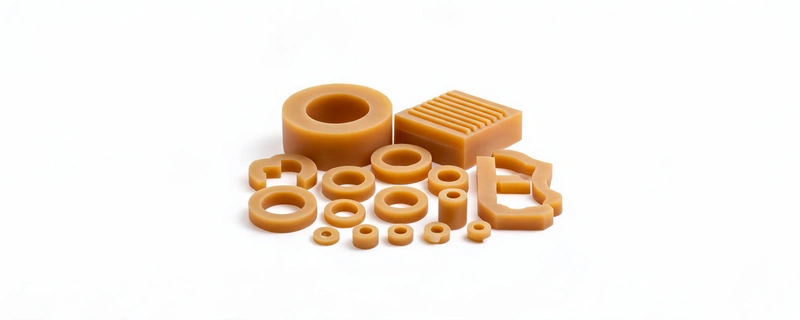
1. What PU Parts Can Be CNC Machined?
Suitable polyurethane stock shapes can be machined into a wide range of custom industrial components. Typical examples include:
- Conveyor rollers: Rollers and roller coverings for material handling systems.
- Bushings and sleeves: Components designed to provide cushioning or wear resistance.
- Sealing components: Custom sealing profiles and selected hydraulic or pneumatic components.
- Wear pads: Contact surfaces, guides and protective strips.
- Impact pads and buffers: Parts designed to absorb impact and repeated contact.
- Custom profiles: Special shapes manufactured according to engineering drawings.
The suitability of CNC machining depends on the available PU stock, hardness, component dimensions and required geometry.
2. Why Is PU Different from Rigid Engineering Plastics?
Many polyurethane grades are elastomeric. They can compress, stretch or bend under relatively modest forces and then recover when the force is removed. This behavior is useful in service but can complicate machining.
When a workpiece is clamped too tightly, its dimensions may change temporarily. Cutting forces can also push the material away from the tool instead of allowing a clean cut. After the part is released, elastic recovery may change the measured dimensions.
For this reason, machining PU requires attention to both the cutting process and the way the finished part is measured.
3. Critical Factors in PU CNC Machining
Tool Selection and Cutting Edge
Sharp cutting edges help shear polyurethane cleanly and reduce material dragging or tearing. High-speed steel and carbide tools may both be suitable, depending on the grade, machining operation and production conditions.
Tool geometry should be selected for the material's hardness and elasticity. A suitable rake angle and clearance help reduce rubbing, but there is no single tool geometry that works for every PU formulation.
Workholding and Clamping Pressure
Clamping is one of the most important considerations when machining soft polyurethane. Excessive pressure can compress or distort the workpiece, leading to inaccurate dimensions after release.
- Use fixtures that support the workpiece over an appropriate area.
- Avoid unnecessary compression during chucking or clamping.
- Consider soft jaws or custom supports for delicate geometries.
- Check whether the part returns to its original shape after release.
Cutting Heat and Chip Removal
Excessive heat can affect surface quality and may cause smearing or material buildup around the cutting edge. Sharp tools, suitable cutting parameters and effective chip removal help reduce heat generation.
Compressed air or a compatible coolant may be considered depending on the grade and machining process. Coolant compatibility and cleaning requirements should be checked before use.
Cutting Parameters
Speed, feed and depth of cut should be selected according to hardness, tool geometry, workpiece dimensions and machine rigidity. Parameters suitable for a hard PU rod may produce poor results on a soft elastomer.
Trial cuts are useful for evaluating cutting behavior, surface finish, deformation and dimensional recovery before machining a production batch.
Elastic Recovery and Dimensional Inspection
PU may recover after the cutting force and clamping pressure are removed. A dimension measured while the workpiece is compressed may not represent its relaxed final size.
For critical components, establish a consistent inspection procedure. Allow the part to relax under controlled conditions before final measurement, and use suitable measuring methods that do not excessively compress the material.
4. Surface Finish and Dimensional Accuracy
Surface finish depends on polyurethane hardness, cutting edge condition, toolpath, cutting parameters and the stability of the workpiece. Soft grades may show more surface deformation or tearing than harder grades.
Dimensional accuracy is also influenced by:
- Hardness and elastic recovery of the selected PU grade.
- Initial stock diameter, straightness and dimensional consistency.
- Part geometry, especially thin walls and narrow sections.
- Clamping pressure and fixture design.
- Cutting forces, heat generation and machining sequence.
- Measurement temperature and inspection pressure.
There is no universal CNC tolerance for all polyurethane parts. Critical dimensions should be reviewed against the actual material grade, component geometry and inspection method before production.
5. Design Tips for CNC Machined PU Components
Avoid Unnecessarily Thin Sections
Thin walls and narrow features can deform during machining or handling. Where the design allows, use sufficient wall thickness and provide support during manufacturing.
Use Suitable Corner Radii
Sharp internal corners can create stress concentrations and may be difficult to machine consistently. Appropriate radii can improve manufacturability and reduce local stress in service.
Consider the Material's Elasticity
Do not treat PU like a rigid metal or hard plastic when setting dimensions. Consider the component's deformation under assembly pressure and operating load, particularly for interference fits and sealing applications.
Specify Functional Requirements
In addition to dimensions, provide hardness, hardness scale, operating temperature, loading conditions and chemical exposure. These details help determine whether the proposed material and geometry are suitable.
6. CNC Machining vs. Molding and Other Processes
CNC machining is useful for custom dimensions, prototypes, small batches and components made from available PU stock shapes. For repeat production of large quantities, molding may be more economical when tooling costs and production volumes justify it.
| Process | Typical Advantages | Important Considerations |
|---|---|---|
| CNC machining | Flexible geometry, no dedicated mold required, suitable for prototypes and custom stock shapes | Material removal, workholding and elastic recovery affect cost and accuracy |
| Molding | Can be economical for repeat production of suitable shapes | Tooling investment, mold design and process control are required |
| Die cutting | Useful for suitable flat profiles and repeat shapes | Limited by material form, thickness and geometry |
The best process depends on part geometry, material type, quantity, tooling investment and dimensional requirements. A cost comparison should consider the complete production route rather than machining cost alone.
7. Information Needed for a PU CNC Machining Quotation
To evaluate a custom polyurethane component, please provide as much of the following information as possible:
- Technical drawing: 2D drawing or 3D CAD file with dimensions.
- Material: PU type or grade, if already specified.
- Hardness: Shore A or Shore D value, including the scale.
- Quantity: Prototype, sample or production quantity.
- Critical tolerances: Identify dimensions that affect assembly or function.
- Operating conditions: Load, speed, temperature and chemical exposure.
- Surface requirements: Specify any functional or visual finish requirements.
If the exact PU grade is not known, application details and operating conditions can help start the material review.
8. Custom PU CNC Parts from Teda Plastics
Teda Plastics supports industrial buyers looking for engineering plastic materials and custom machined components. For polyurethane CNC parts, we can review drawings, dimensions, hardness requirements and application conditions to discuss material suitability and machining feasibility.
Typical inquiries include custom rollers, bushings, sleeves, wear pads, sealing components and impact-resistant parts. Final feasibility and achievable tolerances depend on the selected PU material and part design.
Frequently Asked Questions About PU CNC Machining
1. Can polyurethane be CNC machined?
Yes. Suitable polyurethane stock can be CNC machined into rollers, bushings, seals, wear pads and custom industrial components. The machining strategy must account for material hardness, elasticity, workholding and heat generation.
2. Why is PU difficult to machine accurately?
Polyurethane can deform under cutting and clamping forces and may recover elastically after machining. These effects can influence dimensions and surface finish, especially with softer grades or thin-walled geometries.
3. Which cutting tools are suitable for PU machining?
Sharp cutting tools with suitable geometry are important for clean cutting. High-speed steel or carbide tools may be used depending on the grade, operation and production conditions. Tool selection should be tested on the actual material.
4. How should PU parts be clamped during CNC machining?
Use fixtures that support the workpiece while avoiding excessive compression. Soft polyurethane can deform under clamping pressure, so the holding method should be adapted to the hardness, shape and dimensions of the component.
5. How can heat be controlled when machining polyurethane?
Use sharp tools, suitable cutting parameters and effective chip removal to limit heat buildup. Compressed air or a compatible coolant may be considered where appropriate for the material and process.
6. Can CNC machined PU parts achieve tight tolerances?
Achievable tolerances depend on hardness, geometry, stock quality, workholding, machining conditions and inspection methods. Softer grades and thin sections can be more challenging because of elastic deformation and recovery. Confirm critical tolerances with the machining supplier.
7. Which PU components can be CNC machined?
Common examples include rollers, wheels, bushings, sleeves, seals, wear pads, spacers, buffers and custom-shaped industrial components. Feasibility depends on the stock material and part geometry.
8. When is molding more economical than CNC machining for PU?
For repeat production of large quantities of the same suitable geometry, molding may become more economical after tooling costs are considered. CNC machining is often useful for prototypes, smaller batches, custom dimensions and parts made from available stock shapes.
Need Custom PU CNC Machined Parts?
Send your technical drawing, material requirements and target quantity. Teda Plastics can review your polyurethane component requirements and quotation request.
Request a Quote