What Is PEEK Film?
PEEK (Polyetheretherketone) film is a thin-gauge high-performance thermoplastic material. It combines many of the important characteristics of bulk PEEK, including high thermal resistance, mechanical strength, chemical resistance and electrical insulation.
Compared with conventional polymer films, PEEK film is designed for demanding environments where temperature, dimensional stability and mechanical performance are important. It is used in selected electrical, electronic, aerospace, automotive and industrial applications.
How Is PEEK Film Manufactured?
PEEK film is generally produced through specialized thermoplastic film-forming processes, such as extrusion followed by controlled cooling and processing. Manufacturing conditions influence crystallinity, thickness uniformity, surface quality and final mechanical properties.
PEEK is a semi-crystalline polymer. Its thermal history and cooling conditions can affect the balance between crystalline and amorphous regions. This is important when evaluating dimensional stability, transparency, mechanical performance and subsequent processing.
For demanding applications, buyers should confirm the film grade, production method, surface condition and relevant technical data with the manufacturer.
PEEK Film Thickness and Available Formats
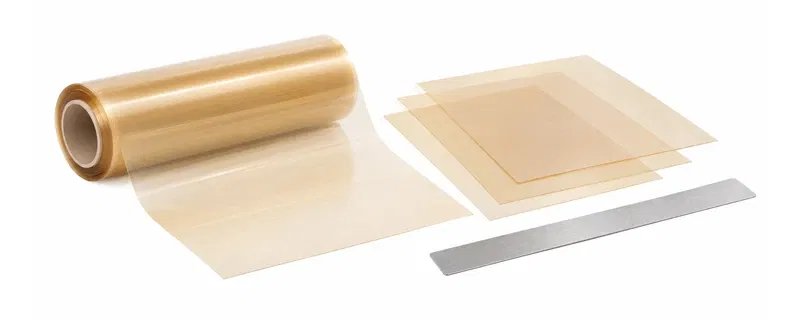
PEEK film can be supplied in roll or sheet formats, depending on the manufacturer and production process. Thickness, width, length and dimensional tolerances should be selected according to the final application.
Thin films may be used for electrical insulation, electronic components and precision converting. Thicker films can be considered where additional stiffness or mechanical durability is required.
The actual thickness range is manufacturer-dependent. The often-mentioned range of approximately 0.01 mm to 0.5 mm should be treated as an indicative market reference, not a guaranteed supply range.
When requesting a quotation, confirm:
- Required film thickness and thickness tolerance.
- Roll or sheet format.
- Required width and length.
- Surface finish and appearance.
- Dimensional and flatness requirements.
- Required grade and technical documentation.
Key Properties of PEEK Film
PEEK film retains many of the performance advantages associated with PEEK resin. Actual film properties depend on thickness, grade, processing conditions and test methods.
Thermal Performance
PEEK has a high melting temperature of approximately 343°C and a glass transition temperature around 143°C. It is commonly selected for applications requiring continuous service temperatures around 250°C. However, the allowable operating temperature of a specific film depends on mechanical loading, exposure time, environment and application design.
Mechanical Strength
PEEK film offers a useful combination of tensile strength, stiffness and toughness. These characteristics make it suitable for thin components that need to maintain mechanical integrity under demanding operating conditions.
Chemical Resistance
PEEK has good resistance to many industrial chemicals, oils and organic solvents. Compatibility depends on the specific chemical, concentration, temperature and exposure duration. Strong oxidizing media and certain aggressive environments require specific compatibility evaluation.
Electrical Insulation
PEEK is an electrical insulating material with useful dielectric properties. Its suitability for a specific electrical application depends on film thickness, voltage, frequency, temperature, humidity and test conditions.
Dimensional Stability
PEEK has relatively low moisture absorption compared with many conventional engineering polymers. Its dimensional behavior is also influenced by temperature, film orientation and manufacturing conditions.
PEEK Film for Electrical Insulation
Electrical insulation is one of the important application areas for PEEK film. Its thermal performance, mechanical properties and dielectric characteristics make it a candidate for selected demanding electrical systems.
Potential applications include:
- Electrical insulation layers in selected components.
- Motor and generator insulation systems.
- Wire and cable insulation components.
- Electronic assemblies exposed to elevated temperatures.
- Specialized insulating films and protective layers.
High-voltage and high-frequency applications require more than a general dielectric-strength value. Partial discharge, corona resistance, electrical aging, film thickness and operating conditions should be evaluated before material selection.
PEEK Film for Acoustic Diaphragms
PEEK film can also be considered for specialized acoustic components, including speaker diaphragms and microphone membranes.
Its mechanical stiffness, low mass at suitable thicknesses and thermal stability can be useful in acoustic designs. However, acoustic performance is not determined by material name alone.
Film thickness, density, modulus, damping behavior, forming process and component geometry all influence frequency response and sound characteristics. Material selection should therefore be validated through prototype testing.
Other Industrial Applications of PEEK Film
Depending on the grade and design, PEEK film may be considered for applications in several industries.
- Aerospace: Selected lightweight insulation and protective components.
- Automotive: Electrical insulation and components exposed to elevated temperatures.
- Electronics: Thin insulating layers and precision electronic components.
- Industrial Equipment: Protective films and specialized functional layers.
- Composite Manufacturing: Specialized processing and release applications, subject to the required surface and thermal characteristics.
PEEK Film vs. PI Film vs. PEI Film
PEEK, PI and PEI are high-performance polymers, but their film properties and processing characteristics differ.
| Property | PEEK Film | PI Film | PEI Film |
|---|---|---|---|
| Thermal Performance | High | Very High | Moderate to High |
| Mechanical Performance | High | High | Good |
| Electrical Insulation | Excellent | Excellent | Very Good |
| Chemical Resistance | Very Good | Grade-dependent | More Limited |
| Flexibility | Grade and thickness dependent | Grade and thickness dependent | Grade and thickness dependent |
| Relative Material Cost | High | High to Very High | Moderate to High |
PI film is widely used where very high thermal performance and electrical insulation are required. PEEK film offers a combination of thermal resistance, mechanical strength and chemical resistance. PEI film may be considered where its specific electrical, mechanical and cost characteristics meet the application requirements.
These comparisons are general guidelines. Actual performance depends on the exact film grade and testing conditions.
PEEK Film vs. PTFE Film
PEEK and PTFE films have different performance priorities.
PTFE film is well known for its extremely low coefficient of friction and outstanding chemical resistance. It is often selected for release, non-stick, sealing and chemical protection applications.
PEEK film generally offers higher mechanical strength and stiffness, making it a potential choice where a thin film must retain its shape and mechanical integrity under load.
The choice depends on the required combination of friction, chemical compatibility, temperature, electrical properties and mechanical performance.
Explore our PTFE material range for additional information.
Processing and Converting Considerations
PEEK film can be converted into different formats using suitable industrial processing methods. The selected process should match film thickness, dimensional tolerances and final component design.
- Slitting: Cutting wider rolls into narrower widths.
- Die Cutting: Producing defined shapes for insulation and industrial components.
- Lamination: Combining PEEK film with other materials using a suitable bonding system.
- Thermoforming: Forming selected film grades into specific geometries under controlled conditions.
PEEK has good chemical resistance, so adhesive bonding can be challenging. Surface treatment, such as plasma treatment or other validated preparation methods, may improve bonding performance in certain systems.
Adhesive selection must consider operating temperature, chemical exposure, mechanical stress and long-term durability.
How to Select the Right PEEK Film
Selecting PEEK film requires a clear understanding of the final application and its operating conditions. Before requesting a quotation, consider the following:
- Required thickness and thickness tolerance.
- Roll or sheet format.
- Required width, length and quantity.
- Operating temperature and exposure duration.
- Electrical insulation or mechanical requirements.
- Chemical environment and service conditions.
- Surface finish and appearance requirements.
- Die cutting, slitting or lamination requirements.
- Required test reports or compliance documentation.
Providing drawings, technical specifications and application details helps identify a suitable material grade and supply format.
Frequently Asked Questions
PEEK Film Supplier – Teda Plastics
Teda Plastics Co., Ltd. supplies high-performance engineering plastics for industrial customers and international buyers.
Our product range includes PEEK, PI, PTFE, PPS, PAI, PEI, PPSU and other engineering plastic materials in different forms, including raw materials, sheets, rods, films and customized CNC machined components.
If you are sourcing PEEK film, please send us your required thickness, dimensions, application details and technical specifications for evaluation and quotation.
Looking for a Reliable PEEK Film Supplier?
Send us your specifications, required dimensions or application details. Our team will help evaluate your PEEK film requirements.
Request a Quote WhatsApp Us