PSU CNC machining is used to produce custom components from polysulfone stock shapes, including sheets, rods and other semi-finished forms. PSU is an amorphous high-performance thermoplastic known for its heat resistance, dimensional stability and useful mechanical properties. Successful machining depends on tool condition, heat management, workholding and control of residual stress.
What Is PSU CNC Machining?
PSU stands for polysulfone, an amorphous engineering thermoplastic with a typical glass transition temperature around 185°C. It is selected for applications requiring a balance of heat resistance, stiffness, dimensional stability and resistance to hot water in suitable grades.
In CNC machining, PSU stock is cut into the required geometry through milling, turning, drilling, tapping and other subtractive operations. This approach is useful for prototypes, custom components, small production batches and parts with complex features.
Compared with metal machining, polymer machining requires additional attention to heat buildup, elastic deformation, clamping pressure and stress relaxation. These factors can influence dimensions during machining and after the part is released from the fixture.
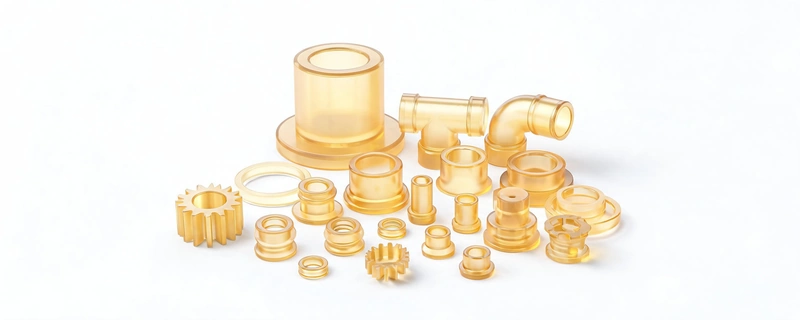
PSU Components We Can Help Machine
Depending on the available stock form, material grade and drawing requirements, PSU can be machined into a range of technical components.
- Fluid-handling components: Custom blocks, manifolds, housings and connectors for selected fluid systems.
- Equipment housings: Protective covers, inspection components and structural housings.
- Electrical components: Insulating supports, fixtures and custom parts where PSU's electrical properties are suitable.
- Industrial components: Brackets, guides, spacers, fixtures and precision-machined technical parts.
- Medical equipment components: Selected housings and non-implantable equipment parts, subject to material and finished-device validation.
- Prototype parts: Custom geometries produced from customer drawings for design evaluation and low-volume requirements.
Medical applications require specific material selection and validation. General-purpose PSU stock should not automatically be described as medical grade or assumed suitable for repeated sterilization.
Critical Factors in PSU CNC Machining
1. Sharp Cutting Tools
Sharp tools help reduce cutting forces, friction and localized heat. Dull tools can rub instead of cutting cleanly, increasing the risk of rough surfaces, burrs, edge damage and dimensional variation.
Tool geometry should be suitable for plastics, with appropriate rake, clearance and edge condition. Tool selection depends on the stock grade, machine setup, feature geometry and production volume.
2. Residual Stress and Stress Relief
Residual stress may be present in semi-finished PSU stock as a result of material production, cooling and previous processing. Machining can release or redistribute this stress, sometimes causing warping or dimensional changes.
For thick sections, complex geometries or parts with demanding dimensional requirements, a staged machining process may be helpful. Rough machining can be followed by a suitable stabilization or stress-relief step and then finish machining.
Annealing is not automatically required for every PSU component. The correct temperature, duration and cooling procedure depend on the material grade, stock dimensions and supplier recommendations. An unsuitable thermal cycle may cause distortion rather than improve stability.
3. Heat Management
Thermoplastics can soften when excessive heat accumulates around the cutting zone. High friction, unsuitable feed rates or poor chip evacuation may lead to smearing, rough surfaces and dimensional changes.
Use sharp tools, balanced cutting parameters and effective chip removal. Coolant or compressed air may be considered where appropriate, but compatibility with the material and finished application should be checked first.
4. Workholding and Clamping
Excessive clamping force can deform PSU stock, particularly when machining thin walls, large flat surfaces or slender features. The part may appear dimensionally correct while held in the fixture, then change shape after release.
Use stable, evenly distributed support and avoid unnecessary clamping pressure. For thin or complex components, custom soft jaws, support fixtures or staged machining may improve consistency.
5. Drilling and Internal Corners
Drilling should be performed with suitable tool geometry and effective chip evacuation. Deep holes may require a controlled pecking strategy to prevent chip packing and excessive heat buildup.
Sharp internal corners can concentrate stress. Where the design allows, use practical internal radii and avoid abrupt changes in wall thickness. This can help reduce stress concentration and improve component durability.
How to Improve Dimensional Accuracy
Dimensional control in PSU machining depends on the relationship between the stock material, machining sequence, part geometry and inspection environment.
- Check stock condition: Review flatness, thickness, surface quality and material consistency before machining.
- Use staged machining: Remove material progressively instead of taking excessive cuts from one side.
- Allow stabilization: For demanding parts, allow the workpiece to stabilize between roughing and finishing operations when appropriate.
- Control clamping: Support the workpiece without forcing it into an unnatural shape.
- Manage cutting heat: Avoid excessive friction and remove chips from the cutting area.
- Inspect under controlled conditions: Measure parts after they have reached a stable temperature and have been released from the fixture.
Surface Finish and Crack Prevention
A good surface finish starts with stable material and suitable cutting conditions. Sharp tools, clean cutting edges and effective chip removal help reduce scratches, burrs and heat-related surface defects.
For components with holes, slots or thin sections, avoid sharp transitions where possible. These features can increase local stress, particularly when the part is exposed to mechanical loads or temperature changes.
After machining, inspect edges, holes and corners for visible defects. If the component will be used in a demanding environment, consider additional dimensional and functional testing rather than relying on visual inspection alone.
PSU CNC Machining vs. Injection Molding
CNC machining and injection molding serve different production needs. The right process depends on quantity, geometry, tooling investment, material availability and dimensional requirements.
| Factor | PSU CNC Machining | PSU Injection Molding |
|---|---|---|
| Initial tooling | Usually lower tooling investment | Requires mold design and tooling |
| Production quantity | Suitable for prototypes and low-volume batches | Often more economical for repeat high-volume production |
| Design changes | Can be adjusted through machining program changes | Design changes may require mold modifications |
| Geometry | Useful for custom features and machined details | Useful for repeatable molded geometries |
| Material use | Material is removed during machining | Material is shaped in the mold, with process-dependent waste |
For prototypes and custom low-volume parts, CNC machining is often a practical option. For stable designs requiring large quantities, injection molding may offer a lower unit cost after tooling investment is considered.
When Should You Choose PSU for CNC Machined Parts?
PSU may be considered when a component needs a combination of heat resistance, dimensional stability, stiffness and useful hot-water performance. Its natural amber transparency may also be useful in selected designs.
However, material selection should always be based on the operating environment. If higher impact toughness or more demanding repeated steam exposure is required, PPSU may be worth comparing. If the application requires a different balance of chemical resistance, wear performance or temperature capability, other engineering plastics may be more suitable.
Information Needed for a PSU CNC Machining Quote
To evaluate a custom PSU machining project, provide the following information where possible:
- 2D engineering drawing and 3D CAD file.
- Required PSU grade or material specification.
- Stock form, dimensions and material color.
- Required quantity and expected order frequency.
- Critical dimensions and geometric tolerances.
- Surface finish requirements.
- Operating temperature and mechanical loading.
- Exposure to water, steam, cleaning agents or chemicals.
- Any relevant regulatory or application documentation requirements.
Providing a drawing with clearly marked critical dimensions helps evaluate machining feasibility, stock allowance, workholding and inspection requirements before production.
Frequently Asked Questions About PSU CNC Machining
1. Can PSU be CNC machined?
Yes. PSU can be machined using suitable CNC milling, turning and drilling operations. Sharp tools, controlled cutting conditions, stable workholding and proper chip removal help achieve good surface quality and dimensional accuracy.
2. Is PSU difficult to machine?
PSU is machinable, but it requires attention to heat generation, residual stress, tool condition and clamping pressure. Thin walls, deep pockets and complex geometries may need staged machining and additional inspection.
3. Does PSU need annealing before CNC machining?
Stress-relief annealing may be useful for certain PSU stock shapes, thick sections, complex parts or components with demanding dimensional requirements. Whether it is needed depends on stock condition, geometry and machining strategy. Follow the material supplier's recommendations and validate the process.
4. What tools are suitable for machining PSU?
Sharp cutting tools designed for plastics are generally preferred. Tool geometry, material, edge condition and cutting parameters should be selected according to the PSU stock grade, machine setup and required surface finish.
5. Can coolant be used when machining PSU?
A compatible coolant may help control cutting temperature and remove chips. However, coolant compatibility should be checked with the PSU grade and finished-part requirements. Some applications may use dry machining or controlled air cooling.
6. What tolerances can be achieved with PSU CNC machining?
Achievable tolerances depend on stock quality, part geometry, dimensions, wall thickness, machining method, temperature and inspection conditions. Critical tolerances should be reviewed against the drawing and confirmed through a machining trial rather than assumed as a universal value.
7. Is PSU suitable for medical device components?
Selected PSU grades may be considered for certain medical equipment components, but not all PSU materials are medical grade. The exact resin documentation, manufacturing controls, sterilization conditions and finished-device requirements must be evaluated.
8. When should PSU parts be CNC machined instead of injection molded?
CNC machining is often practical for prototypes, low-volume production, custom dimensions and parts that do not justify injection mold tooling. Injection molding may be more economical for repeat high-volume production when the design is stable.
Need Custom PSU CNC Machined Parts?
Send Teda Plastics your drawings, material requirements and target quantity. We can discuss suitable PSU stock and machining options for your project.
Request a CNC Machining Quote