PES CNC machining is a practical manufacturing option for custom components that require thermal performance, stiffness and dimensional stability. Polyethersulfone can be machined into prototypes, small-batch parts and complex geometries from suitable semi-finished stock.
PES is an amorphous high-performance thermoplastic known for its relatively high glass transition temperature, rigidity and resistance to hot water in suitable grades. These characteristics make it useful in selected fluid-handling, electrical, industrial and healthcare-related applications.
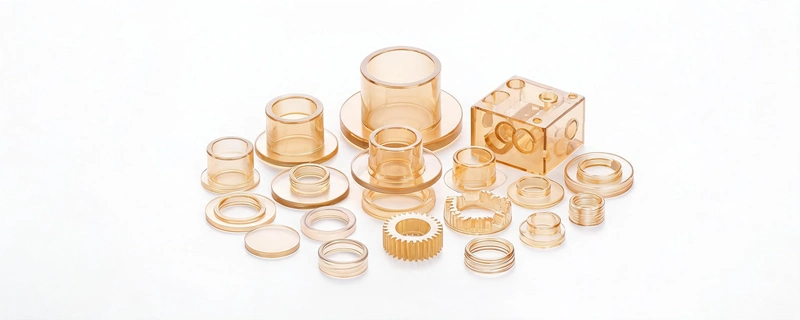
1. What PES Components Can Be CNC Machined?
PES semi-finished stock can be machined into different shapes according to engineering drawings. The final application and material grade determine whether PES is an appropriate choice.
- Fluid-handling components: Custom manifolds, connectors, housings and selected fluid-contact parts.
- Industrial components: Insulating parts, structural components and precision-machined fittings.
- Electrical components: Selected insulating supports, housings and components requiring dimensional stability.
- Healthcare-related components: Parts made from suitably documented grades, subject to application and regulatory validation.
- Prototypes: Custom parts for design evaluation and functional testing before larger-scale production.
Not every PES grade is intended for every application. Material selection should consider temperature, mechanical loading, chemical exposure, sterilization requirements and applicable compliance documentation.
2. Important Factors in PES CNC Machining
Cutting Tool Selection
Sharp cutting edges and stable tool geometry are important when machining PES. Worn or unsuitable tools can increase cutting forces, generate excessive heat and contribute to poor surface quality or dimensional problems.
Tool selection should take into account the PES grade, whether the stock contains fillers, the machining operation and the required surface finish. Glass- or mineral-filled materials, where applicable, may increase tool wear.
Machining Stress and Material Stability
Like other engineering thermoplastics, PES can develop or retain internal stresses during stock production, cooling, storage and machining. Removing substantial material from one side of a part may release these stresses and cause dimensional movement.
For complex geometries or parts with demanding dimensional requirements, a staged machining strategy may help. Rough machining, controlled stabilization and finish machining can be considered according to the material and part design.
Coolant and Heat Management
Heat generated during cutting should be controlled to reduce the risk of local softening, poor surface finish and dimensional variation. A compatible coolant may help remove heat and clear chips from the cutting area.
Coolant compatibility must be checked against the specific PES grade and the finished component's intended service environment. Some operations may also be performed without coolant when cutting conditions and chip evacuation are properly controlled.
Clamping and Workpiece Support
Excessive clamping pressure can deform plastic stock, especially when machining thin walls, narrow sections or irregular geometries. Use stable support and appropriate clamping forces to avoid introducing unnecessary deformation.
Thin features and long components may require additional support during machining. The workholding method should maintain rigidity without placing excessive stress on the material.
3. Does PES Need Stress-Relief Annealing?
Annealing is not automatically required for every PES component. It may be considered when the part has a complex geometry, substantial material removal, tight dimensional requirements or a machining sequence likely to release residual stress.
The appropriate treatment depends on the stock grade, initial material condition, part dimensions and supplier recommendations. Temperature, holding time and cooling procedure should not be selected using a universal schedule.
4. Dimensional Accuracy and Surface Finish
CNC machining can produce accurate PES components, but achievable tolerances depend on more than the machine's positioning capability. Material grade, stock quality, part geometry, machining strategy, clamping and inspection conditions all influence the final result.
For better dimensional control, consider the following practices:
- Confirm the material grade and stock dimensions before machining.
- Review critical dimensions and geometric tolerances on the drawing.
- Avoid unnecessarily thin walls and unsupported features where possible.
- Use staged material removal for parts with complex geometries.
- Allow the component to stabilize before final inspection when appropriate.
- Specify the inspection method for critical dimensions.
There is no single tolerance value that applies to every PES part. Critical dimensions should be reviewed individually and agreed upon during the manufacturability assessment.
5. PES CNC Machining vs. Injection Molding
CNC machining and injection molding serve different production needs. The preferred process depends on order quantity, geometry, tooling investment, material availability and dimensional requirements.
| Consideration | CNC Machining | Injection Molding |
|---|---|---|
| Typical production | Prototypes and small batches | Repeat production and larger volumes |
| Initial tooling | Usually lower dedicated tooling investment | Requires mold design and tooling |
| Design changes | Often easier to accommodate | May require mold modifications |
| Part geometry | Suitable for many machined geometries | Must be designed around molding requirements |
| Material use | Material is removed during machining | Material is shaped in a mold |
| Production economics | Useful when quantities are limited | Can become more economical at suitable volumes |
For repeated production of large quantities, injection molding may offer better unit economics after tooling costs are considered. CNC machining is often more practical for prototypes, custom designs and smaller production runs.
PES granules must be a grade formulated for the intended molding process. Processing conditions should always follow the resin manufacturer's technical data sheet.
6. Design Tips for CNC Machined PES Parts
A well-prepared drawing can reduce machining difficulty and improve the consistency of finished components. Consider these points during the design stage:
- Avoid sharp internal corners: Add suitable radii to reduce stress concentration and simplify tool access.
- Review wall thickness: Avoid unnecessarily thin sections that may deform during clamping or machining.
- Specify critical tolerances: Apply tight tolerances only where functional requirements justify them.
- Consider machining access: Design holes, pockets and internal features with realistic tool access in mind.
- Define surface requirements: Identify sealing surfaces, sliding areas and other functional finishes clearly.
- Confirm the material grade: Specify the required grade where application or compliance requirements make it important.
7. When Is PES CNC Machining the Right Choice?
PES CNC machining may be a suitable option when you need:
- Custom components manufactured from PES sheet or rod stock.
- Prototype parts before committing to injection mold tooling.
- Small production batches with changing design requirements.
- Machined features that are difficult to incorporate into a molded design.
- Components requiring a high-performance thermoplastic with suitable thermal and mechanical characteristics.
It may be less suitable when a design requires very high production volumes, highly complex molded features or a material grade that is not available in an appropriate machinable stock form. These factors should be reviewed before selecting the manufacturing route.
8. Custom PES CNC Machined Parts from Teda Plastics
Teda Plastics supplies engineering plastic materials and supports custom machined component inquiries based on customer drawings and application requirements.
When requesting a quotation for PES CNC machined parts, please provide:
- 2D engineering drawing or 3D CAD file.
- Required PES grade, if already specified.
- Order quantity and expected repeat-order requirements.
- Critical dimensions and tolerance requirements.
- Surface finish and inspection requirements.
- Operating temperature, media exposure and intended application.
These details help us review the material and manufacturing requirements before discussing a suitable production approach.
Frequently Asked Questions
1. Can PES be CNC machined?
Yes. PES can be machined using conventional CNC milling, turning and drilling processes when suitable stock material and cutting conditions are selected. It is often considered for prototypes, custom geometries and low-volume components.
2. What cutting tools are suitable for PES machining?
Sharp, properly maintained cutting tools are important for PES machining. Tool material and geometry should be selected according to the workpiece grade, reinforcement, machine setup, production volume and required surface finish.
3. Does PES need annealing before CNC machining?
Not every PES part requires annealing. Stress-relief treatment may be considered for complex geometries, substantial material removal or demanding dimensional requirements. The temperature and duration should follow the stock supplier's recommendations.
4. Can coolant be used when machining PES?
A compatible coolant may help control heat and remove chips during PES machining. Coolant compatibility should be checked with the specific PES grade and the finished part's service environment. Dry machining may also be suitable for some operations.
5. What tolerances can be achieved with CNC machined PES parts?
Achievable tolerances depend on part geometry, material grade, stock condition, machining strategy, equipment, fixturing and inspection conditions. Critical dimensions should be reviewed against the drawing and agreed before production.
6. Is PES suitable for medical components?
Certain PES grades are used in medical and healthcare-related applications. Suitability depends on grade documentation, regulatory requirements, sterilization method and validation of the finished component. Not all PES stock is medical grade.
7. When is injection molding better than CNC machining for PES?
Injection molding may be more economical for repeat production of large quantities when the part design is stable and tooling costs can be justified. CNC machining is often useful for prototypes, small batches and components with custom geometries.
8. What information is needed for a PES CNC machining quotation?
Useful information includes a 2D drawing or 3D CAD file, material grade if specified, quantity, critical tolerances, surface finish requirements and intended application. These details help assess manufacturability and quotation requirements.