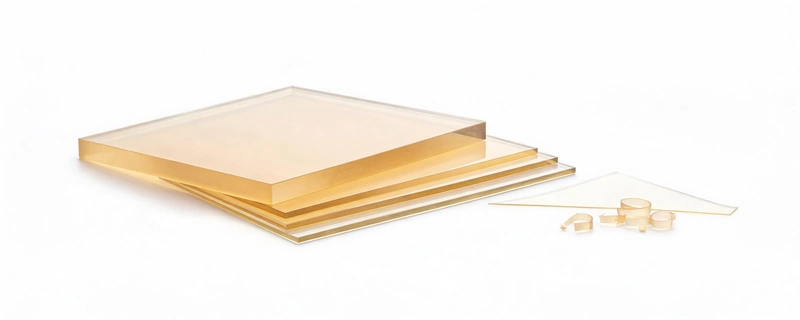
PES (Polyethersulfone) sheet is a high-performance amorphous thermoplastic used in applications that require a combination of stiffness, thermal performance, dimensional stability and resistance to hot water. Its natural appearance is often translucent to transparent with an amber tint, making it useful in selected applications where both material performance and visual inspection are important.
PES is part of the sulfone polymer family, alongside PSU and PPSU. Although these materials share some characteristics, their mechanical properties, impact performance and chemical compatibility are not interchangeable. Choosing the right grade is essential for demanding industrial applications.
1. What Is PES Sheet?
PES sheet is a semi-finished plastic material manufactured from polyethersulfone resin. It is an amorphous engineering thermoplastic valued for its relatively high stiffness, thermal stability and performance in hot-water environments.
Unlike semi-crystalline plastics such as PEEK or PPS, PES does not have a crystalline melting point in the same way. Its thermal behavior is associated with its glass transition temperature, which is typically around 225°C for many standard PES materials. The exact value depends on the grade and formulation.
Natural PES often has a transparent amber appearance. However, sheet thickness, manufacturing conditions, additives and the specific resin grade can affect its color and light transmission.
2. Key Properties of PES Sheet
Thermal Performance
PES maintains useful mechanical performance at elevated temperatures compared with many conventional engineering plastics. Its relatively high glass transition temperature makes it suitable for components exposed to heat, provided the operating load and exposure conditions are within the selected grade's limits.
Hydrolysis Resistance
PES is known for its resistance to hot water and hydrolysis in suitable environments. This characteristic makes it a candidate for selected fluid-handling, water-treatment and equipment applications. Actual performance depends on water chemistry, temperature, pressure and exposure duration.
Dimensional Stability
PES offers good stiffness and dimensional stability for many precision applications. Nevertheless, residual stress from sheet production, cutting or machining can affect the dimensions of finished components. Proper stock selection and machining procedures remain important.
Electrical Insulation
PES provides useful electrical insulating properties and can be considered for electrical and electronic components exposed to heat. The appropriate grade should be selected according to voltage, temperature, humidity and applicable electrical requirements.
3. Typical Applications of PES Sheet
Fluid Handling and Water Treatment
PES can be used for selected fluid-handling components, equipment housings and structural parts where hot-water resistance and dimensional stability are important. Chemical compatibility must be confirmed against the actual process fluid.
Medical and Laboratory Equipment
Certain PES grades are used in medical, laboratory and healthcare-related equipment. Potential applications include equipment housings, trays and selected reusable components. Medical suitability is not determined by the polymer name alone; grade documentation, sterilization validation and finished-device requirements must all be considered.
Electrical and Electronic Components
PES sheet may be machined into insulating supports, structural parts and electrical equipment components where heat resistance and dimensional stability are required.
Industrial Equipment
In industrial machinery, PES can be considered for custom parts exposed to elevated temperatures or hot-water environments. The final choice should account for mechanical loading, chemical exposure and the expected service life.
4. Can PES Sheet Withstand Steam Sterilization?
Some PES grades are suitable for repeated exposure to hot water and steam. This is one reason the material is considered for certain reusable equipment and laboratory applications.
However, steam sterilization performance should never be assumed without checking the exact grade. The sterilization temperature, pressure, cycle duration, cooling procedure and total number of cycles can all influence the service life of a component.
Before selecting PES for sterilization-related applications, check:
- The resin manufacturer's steam and hot-water resistance data.
- The actual sterilization temperature and cycle duration.
- Dimensional changes after repeated exposure.
- Mechanical performance after the required number of cycles.
- Compatibility with cleaning agents and disinfectants.
5. PES Sheet CNC Machining Considerations
PES sheet can be machined into custom components using conventional plastic CNC machining methods. However, precision results depend on material condition, part geometry, tooling and machining parameters.
Use Sharp Cutting Tools
Sharp, suitable cutting tools help reduce friction, heat generation and surface damage. Tool geometry should be selected according to the sheet grade, machining operation and required surface finish.
Control Heat During Machining
Excessive local heat can affect surface quality and dimensional consistency. Appropriate cutting speeds, feed rates, chip evacuation and cooling methods should be considered. Coolant compatibility should also be checked before use.
Manage Internal Stress
Residual stress may be present in semi-finished sheet stock. Removing large amounts of material from one side can cause distortion or dimensional movement. For demanding components, staged machining and a suitable stress-relief procedure may help improve stability.
Support Thin Sections
Thin walls and narrow features can vibrate or deform during machining. Stable workholding, suitable support and controlled cutting forces help protect the component geometry.
6. PES vs. PSU vs. PPSU: What Is the Difference?
PES, PSU and PPSU are all sulfone-based engineering thermoplastics. They are often considered for high-temperature equipment, fluid handling and electrical applications, but each material has a different balance of properties.
PES
PES is often selected when stiffness, thermal performance and dimensional stability are important. It also offers useful hydrolysis resistance in suitable environments.
PSU
PSU is known for its transparency, dimensional stability and performance in hot-water applications. It may be suitable where these characteristics meet the application requirements.
PPSU
PPSU is often considered when impact resistance and repeated hot-water or steam exposure are important. It is widely associated with demanding reusable equipment applications, subject to grade-specific validation.
No material is automatically the best choice for every application. Compare the relevant grades using mechanical data, chemical compatibility, sterilization requirements and total component cost.
7. How to Select the Right PES Sheet
Before ordering PES sheet, define the technical and dimensional requirements of the finished component. This helps avoid selecting material based only on appearance or a general property description.
- Dimensions: Specify required sheet length, width and thickness.
- Material grade: Confirm the resin grade and any special formulation requirements.
- Operating temperature: Provide normal and peak temperatures, along with exposure duration.
- Environment: Identify contact with water, steam, cleaning agents or process chemicals.
- Mechanical requirements: Describe loads, impact conditions and dimensional tolerances.
- Documentation: State any required technical data, compliance documents or application-specific records.
For CNC-machined components, drawings with dimensions, tolerances, surface finish requirements and expected quantities are also helpful.
8. PES Sheet Supply from Teda Plastics
Teda Plastics supplies engineering plastic materials for industrial buyers, distributors and machining companies. We support material selection and quotation requests based on the required product form, dimensions and application.
Our engineering plastic product range includes:
- PES sheets and other semi-finished plastic stock shapes.
- Engineering plastic rods and tubes, subject to material availability.
- Selected resin powders and granules.
- Custom CNC-machined plastic components based on customer drawings.
If you are sourcing PES sheet for industrial equipment, fluid-handling components or precision machining, send us your required dimensions, grade and application details for a quotation.
Frequently Asked Questions About PES Sheet
1. What is PES sheet?
PES sheet is made from polyethersulfone, an amorphous high-performance thermoplastic known for its stiffness, thermal performance, dimensional stability and resistance to hot water and hydrolysis in suitable environments.
2. Is PES sheet transparent?
Natural PES is commonly translucent to transparent with an amber or brownish tint. Actual appearance depends on grade, thickness, processing and additives.
3. Can PES sheet withstand steam sterilization?
Certain PES grades can withstand repeated hot-water or steam exposure, but suitability depends on the grade, sterilization temperature, cycle duration, pressure and number of cycles. Always verify the manufacturer's data.
4. What is the continuous service temperature of PES sheet?
There is no single continuous service temperature that applies to every PES grade. Thermal suitability depends on mechanical load, exposure time, environment and the manufacturer's grade-specific technical data.
5. Is PES sheet suitable for CNC machining?
Yes. PES sheet can be machined into custom components using suitable sharp tooling, stable workholding and controlled cutting conditions. A machining trial may be needed for demanding tolerances or thin sections.
6. Is PES resistant to chemicals?
PES offers resistance to many aqueous environments, but it is not universally chemically resistant. Compatibility with solvents, cleaning agents and process fluids should be checked at the actual concentration and operating temperature.
7. What is the difference between PES, PSU and PPSU?
PES, PSU and PPSU are different sulfone-based engineering thermoplastics. Their balance of stiffness, impact resistance, thermal performance and chemical compatibility varies by grade and application.
8. What information is needed when ordering PES sheet?
Useful ordering details include sheet dimensions, thickness, quantity, material grade, required tolerances, operating environment and any relevant compliance or documentation requirements.
Looking for PES Sheet or Custom Machined Parts?
Contact Teda Plastics with your required dimensions, material specifications or technical drawings. Our team can help you review your requirements and prepare a quotation.
Request a PES Quote